
Cultural change management is the deliberate, often difficult, work of shifting an organisation’s underlying values, beliefs, and behaviours to get behind new strategic goals. This isn’t about surface-level perks like free snacks; it’s the fundamental task of reshaping how people work together, make decisions, and drive results.
When you’re bringing Objectives and Key Results (OKRs) into your business, this isn’t just some HR initiative it’s the absolute foundation for success.
Why Culture Is Your Company’s Operating System

Think of your company’s culture as its operating system (OS). It runs quietly in the background, dictating how every single application from your sales process to your product development cycle actually functions. When you decide to install a powerful new piece of software like OKRs, you expect it to run flawlessly.
But if your cultural OS is outdated, it simply can’t support the new software. A culture built on top-down control, a fear of failure, and siloed information will actively reject the core principles of transparency and ambition that OKRs demand. The software crashes, not because it’s faulty, but because the underlying system is completely incompatible.
The Real Reason OKRs Fail
So many leaders get frustrated when their perfectly crafted OKRs fall flat. They blame the framework, the tools, maybe even the teams. But the real lesson is this: OKRs don’t fail because the framework is flawed; they fail because the culture isn’t ready for them.
Learning Moment: The success of an OKR programme is almost entirely dependent on the psychological safety, accountability, and transparency embedded in the organisational culture. Without these, you’re just installing an app on an incompatible operating system.
This guide moves beyond the buzzwords to give you a practical roadmap. We’ll show you how to intentionally upgrade your company’s cultural OS so it doesn’t just support your strategy, but actively accelerates it. Using tools like an OKR generator can be a huge help here, giving you a solid structure right from the start.
Mastering cultural change management is the ultimate leadership skill for driving real, measurable results. An organisation’s ability to hit its strategic goals is directly tied to the strength of its culture. For a deeper look, you can learn more about achieving strategic alignment in our dedicated article.
To succeed with OKRs, you have to start with the foundational elements of how your organisation operates. The next sections will walk you through diagnosing your current culture and pulling the right levers to build one that thrives on ambition and focus.
How to Diagnose Your Current Company Culture

Before you can steer your organisation towards a new destination, you need an accurate map of where you are right now. Kicking off a cultural change management programme without a clear diagnosis is like setting sail without knowing your starting port. You’ll definitely be busy, but you’ll have no idea if you’re heading in the right direction.
Many leaders fall into the trap of relying on gut feelings, but a tangible, evidence-based approach will always win out. The good news? Your company’s culture isn’t invisible. It leaves fingerprints everywhere, you just need to know where to look.
To make this practical, let’s break it down into three areas you can actually observe: what you see, what people do, and what the organisation rewards. This simple framework pulls culture out of the clouds and turns it into a set of concrete data points you can properly analyse.
Uncovering Cultural Artefacts
The most obvious clues to your culture are its artefacts, the tangible things you can see, hear, and touch. Think of yourself as a detective arriving at a scene. What do the immediate surroundings tell you?
Take your office layout, for instance. Do senior leaders have their own corner offices, sealed off from the rest of the teams? That often points to a culture of hierarchy. On the other hand, an office where leaders sit out in the open with their people sends a clear signal of accessibility and collaboration.
Your communication style is another huge giveaway. Glance through company-wide emails or your main Slack channels. Is the language stiff, formal, and loaded with corporate jargon? Or is it informal, direct, and encourages a bit of back-and-forth? This tells you a lot about whether your culture values rigid process or dynamic interaction.
Analysing Behaviours and Actions
Next, zoom in on the behaviours the consistent ways your people act and react, especially when the pressure is on. This is where culture really comes to life. Meetings are a perfect laboratory for observing this in action.
How are decisions made? Does one person do all the talking while everyone else nods along, or is there a genuine debate where different viewpoints are welcomed? A meeting that wraps up with clear action items and owners demonstrates a culture of accountability. One that just fizzles out suggests a serious lack of ownership.
Perhaps the most telling behaviour of all is how your organisation handles failure. When a project goes south, is the first instinct to find someone to blame? Or is the focus on a blameless post-mortem to figure out what can be learned? Celebrating a team for a bold attempt that didn’t quite land sends a powerful message that you value psychological safety and innovation over just playing it safe.
Examining Underlying Systems
Finally, you have to dig into your systems, the formal structures that reinforce and reward certain behaviours. These are the powerful, often unseen, currents that guide your organisation. If your artefacts and behaviours are the “what,” your systems are the “why.”
Learning Moment: Promotion criteria are a direct reflection of what an organisation truly values. If you claim to want teamwork but only promote individual ‘heroes,’ your system is actively working against your desired culture.
Your budget is another direct window into what you truly value. Where does the company put its money? A healthy investment in employee training and development shows a commitment to growth. In contrast, a reluctance to fund cross-functional projects reveals a culture that prefers siloed thinking over genuine collaboration.
By looking closely at these three areas, artefacts, behaviours, and systems, you can build a detailed, evidence-based picture of the culture you have today. This gives you the solid foundation you need to design a change strategy that will actually work.
Your Organisational Culture Health Check
To get you started, use this self-assessment tool to score your organisation’s readiness for an OKR-driven culture. Rate each statement honestly on a scale of 1 (Strongly Disagree) to 5 (Strongly Agree).
Organisational Culture Health Check Template
This simple exercise will quickly highlight your biggest strengths and, more importantly, the areas that need urgent attention before you roll out OKRs.
| Cultural Dimension | Assessment Statement | Score (1-5) |
|---|---|---|
| Transparency | Information about company strategy and performance is openly and regularly shared with all employees. | |
| Accountability | Teams and individuals have clear ownership of their goals and are trusted to deliver without micromanagement. | |
| Alignment | There is a clear, visible connection between an individual’s work and the company’s top priorities. | |
| Psychological Safety | Employees feel safe to voice dissenting opinions, admit mistakes, and take calculated risks without fear of blame. | |
| Focus | The organisation is disciplined about prioritising a few critical objectives rather than trying to do everything at once. |
Once you’ve completed the scores, you’ll have a much clearer picture of your starting point and can begin planning a change journey with your eyes wide open.
The Five Levers for Driving Cultural Change
Diagnosing your culture is a critical first step, but a map is only useful if you know how to move. To drive real transformation, you need practical tools. Think of cultural change management not as one single, monumental push, but as the coordinated use of several distinct levers.
Pulling these levers in isolation might create a temporary shift, but using them together is what creates sustained momentum. Each one targets a different part of your organisation’s DNA, from leadership actions to everyday routines. Let’s dig into the five most important levers you can pull to reshape your culture and get it ready for OKR success.
1. Leadership Modelling
Culture change starts and ends with leadership. Simple as that. Your people are experts at spotting hypocrisy; if leaders say one thing but do another, the change initiative is dead in the water before it even begins. Executives must become the living, breathing embodiment of the new culture.
It’s not enough to endorse the change; you have to visibly model it in your daily actions. This means leaders must be the most disciplined practitioners of the new behaviours they expect from everyone else.
Practical Example: A CEO wants to build a culture of intense focus. Instead of just talking about it, they could start every single all-hands meeting by transparently reviewing their own OKRs. They might say, “Our Objective is to delight our enterprise customers. My KR is to personally speak with 10 CEOs of our key accounts this quarter. I’ve spoken to 4 so far, so I’m behind. Here’s my plan to catch up.” That single act does more to reinforce focus and accountability than a hundred memos ever could.
2. Communication and Storytelling
Once leaders are modelling the way, the next lever is to craft a compelling story around the change. Humans are wired for stories, not for corporate jargon or abstract strategic plans. A clear and consistent narrative helps everyone understand the ‘why’ behind the shift, connecting their individual work to a bigger, shared purpose.
This isn’t about a one-off announcement. It’s about relentless, multi-channel communication that reinforces the vision again and again.
Learning Moment: An effective change narrative doesn’t just explain what is changing; it inspires people to want to be part of that new future. It frames the journey as a shared challenge with a meaningful reward.
Practical Example: A company rolling out OKRs wants to move from a “stay busy” culture to an “achieve outcomes” culture. Instead of just focusing on the mechanics, leaders constantly find and share stories. They might highlight a product team that used their OKRs to say “no” to five distracting feature requests, allowing them to finally ship a critical, revenue-generating update. This makes the value of the change real and relatable.
3. Rituals and Routines
Culture is ultimately a collection of shared habits. So, to change the culture, you have to intentionally design and embed new habits into the daily, weekly, and monthly rhythm of the organisation. These are the rituals and routines that make the new way of working the default way of working.
These don’t need to be complicated. Simple, consistent rituals can have a huge impact over time by creating new muscle memory.
- Daily Stand-ups: Instead of a simple status update, each person answers: “What did I do yesterday to move our Key Results forward, and what will I do today?”
- Weekly Wins: Creating a company-wide ‘Win of the Week’ Slack channel where teams exclusively share progress on their OKRs.
- Monthly Reviews: Establishing a transparent, blame-free forum where leaders and teams review OKR progress and learnings.
By weaving these new routines into the fabric of the workday, you make the desired culture an active, lived experience rather than just a concept on a slide deck.
4. Recognition and Rewards
People do what gets rewarded. If your incentive structures are misaligned with your desired culture, you are actively encouraging people to cling to old behaviours. This lever involves consciously aligning both formal and informal recognition systems with the new cultural values you want to see.
This is often where organisations stumble, especially when it comes to fostering psychological safety. For expert guidance on equipping your leaders, explore our detailed insights into OKR training for managers and how it fosters strategic focus.
Practical Example: A company wants to encourage ambitious “stretch goals.” A team sets a goal to increase user sign-ups by 50% but only achieves 35%. In a traditional culture, this might be seen as a failure. In the new culture, the leadership team publicly celebrates them in the company all-hands, praising the bold attempt and asking the team lead to share what they learned. This sends an undeniable message that learning from ambitious attempts is just as important as winning.
5. Skills and Systems
Finally, you can’t expect people to adopt new ways of working without giving them the necessary skills and supportive systems. It’s both unfair and ineffective to demand a culture of radical candour if you haven’t trained people on how to give and receive constructive feedback.
This lever ensures your team is actually equipped for success. It involves auditing your existing systems from performance management to project management tools and investing in building capability where you find gaps.
Practical Example: If your OKRs require more cross-functional collaboration, but your project management tool keeps teams in separate silos, you’re setting them up to fail. The practical step is to invest in a tool like Asana or Jira that allows for shared, cross-departmental project boards and provide training on how to use them effectively. This shows you are genuinely invested in their success.
Bridging the Leadership Perception Gap
In any cultural change, the biggest hurdle often isn’t a bad strategy or a lack of cash; it’s the invisible wall between leaders and their teams. This is the leadership perception gap, the chasm between what leaders think they’re doing and what employees actually see day-to-day. It’s a silent killer of momentum.
The issue isn’t about pointing fingers. It’s about awareness. Most leaders have the best intentions. They genuinely believe they’re building an agile, transparent, and innovative culture. The problem is, the reality on the ground can be miles apart, and that disconnect breeds cynicism fast, eroding trust before you’ve even started.
So, how does this happen? As leaders move up the ladder, they can become insulated from the daily grind their teams face. This bubble, combined with our own natural biases, creates a feedback vacuum where their view of the culture drifts further and further from the truth.
The Stark Reality of the Perception Gap
Research paints a pretty sobering picture of this disconnect in UK organisations. Recent studies show a massive gap between what executives believe and what their teams experience. For example, while a staggering 97% of C-suite members think they model agile behaviours, only a tiny 2% of delivery teams agree with them.
The divide doesn’t stop there. When it comes to adapting to change, 80% of executives feel leaders do it well, a view shared by just 15% of senior leaders. And while 91% of the C-suite believes experimentation is encouraged, only 35% of teams feel the same way. You can dig into all the details in the full 2023 State of Agile Culture report.
Learning Moment: Your impact as a leader is not defined by your intent, but by your team’s perception. Closing the gap between the two is the most critical work you can do to drive genuine cultural change.
This data is a huge learning moment. It tells us loud and clear that good intentions are not enough. If leaders aren’t actively seeking unfiltered feedback and grounding their change plans in the lived reality of their people, they’re essentially flying blind.
The infographic below shows the key levers leaders can pull—leadership, communication, and rewards—to start closing this gap.
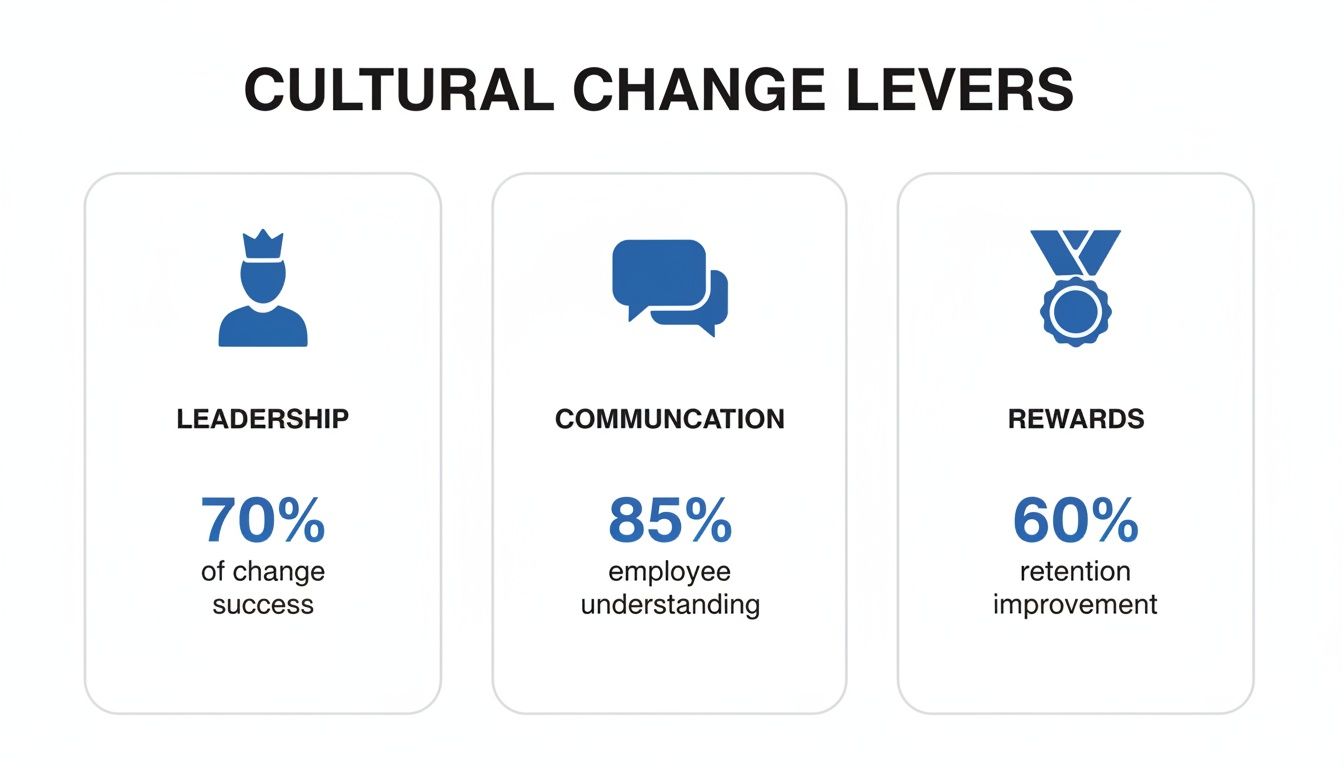
As you can see, while all three levers matter, it’s leadership action that gives real weight to any communication or reward strategy.
Actionable Strategies to Close the Gap
To really bridge this gap, leaders need to get their hands dirty. It means moving beyond assumptions and actively creating a positive workplace culture. You have to build systems that invite honest, unfiltered feedback. Here are three practical ways to ground your leadership in reality.
Run ‘Ask Me Anything’ (AMA) Sessions with No Filters
Forget the polished town halls. Host regular, unscripted Q&A sessions where any question is fair game and gets an honest answer, even the tough ones. Using an anonymous submission tool is a great way to encourage people to ask what’s really on their minds.Create a ‘Shadow Board’ of Junior Employees
A shadow board is a group of non-executive, high-potential people from different parts of the business who advise the senior leadership team. They bring fresh perspectives on big decisions and offer a direct, unfiltered view of how new policies are actually landing on the front lines, completely bypassing the usual layers of management.Implement Anonymous Upward Feedback Tools
Go beyond the big annual employee survey. Use lightweight, frequent, and anonymous pulse survey tools to get a continuous read on leadership effectiveness and cultural health. This gives you real-time data on how your teams are feeling, letting you tweak your approach before small issues mushroom into major roadblocks.
By putting these practices into play, leaders can start to break down the invisible walls that isolate them. It allows them to lead change with real empathy and authenticity, building their efforts on a foundation of trust and a shared sense of reality.
Building a More Inclusive and High-Performing Culture

Real cultural change management is about more than just tweaking processes; it’s about building a fundamentally better place to work. A high-performing, OKR-driven culture and a diverse, equitable, and inclusive (DEI) one aren’t separate goals. They’re two sides of the same coin.
Both are completely dependent on a foundation of genuine psychological safety. Without it, you can’t get the ambitious goal-setting that fuels great OKRs, and you certainly can’t have the open, honest conversations needed for true inclusivity. When people feel safe enough to bring their unique perspectives to the table without fear, both performance and a sense of belonging thrive.
This connection is a powerful lesson for leaders: focusing on DEI isn’t a distraction from performance, it’s a direct accelerator. An inclusive environment is a high-performing environment.
From Aspiration to Accountability
For too long, DEI initiatives have been stuck as well-intentioned but vague corporate statements. They often lack the teeth to drive real change because they aren’t treated with the same rigour as other business priorities. This is exactly where the OKR framework becomes an indispensable tool.
OKRs take DEI from a nice-to-have platitude and turn it into a measurable, strategic imperative. By applying the discipline of setting clear Objectives and time-bound Key Results, you make equity and inclusion an accountable goal for the whole organisation.
Learning Moment: The real power of OKRs is their ability to translate abstract aspirations into concrete action. When you apply this to DEI, you move from saying you value inclusion to actively building an inclusive culture, with clear metrics to prove it.
This approach forces the difficult but essential conversations about what success actually looks like. It turns broad ambitions into specific, measurable outcomes that leaders can, and should, be held accountable for.
Making DEI Measurable with OKRs
Systemic issues need intentional, focused intervention, and data is the only place to start. In the UK, cultural change is increasingly centred on diversity and inclusion. For example, the average median gender pay gap in UK infrastructure companies hit 21.2% in 2022-23, a worrying increase of two percentage points from the previous year. This highlights just how urgent cultural transformation is as businesses roll out policies to boost psychological safety. You can read more about the efforts to improve diversity in UK infrastructure.
This is precisely the kind of challenge where OKRs can drive focused, meaningful action. Let’s look at how that works in practice.
Imagine a company wants to move beyond statements and make a real difference. They might set an ambitious Objective like this:
- Objective: Become a recognised industry leader in workplace equity and belonging.
That sets a clear, inspirational direction. But to make it real, it needs to be grounded in measurable Key Results that hold everyone to account.
- Key Result 1: Reduce the median gender pay gap from 15% to 10% within 18 months.
- Key Result 2: Increase the ‘sense of belonging’ score from 75% to 90% in the annual employee survey.
- Key Result 3: Achieve a 40% representation of women in senior leadership roles (Director level and above) by Q4.
Suddenly, the goal is no longer abstract. It’s a specific, time-bound challenge with undeniable success metrics. Every leader, from the C-suite to team managers, now has a shared responsibility to contribute to these outcomes, turning a cultural value into a core business priority.
Your 90-Day Cultural Change Action Plan
Successfully shifting your company culture isn’t just a nice idea; it’s a project. And like any good project, it needs a clear plan, real milestones, and people who own the outcome. This 90-day sprint is designed to turn the concepts we’ve covered into a practical roadmap, giving you immediate momentum as you roll out your OKRs.
We’ve broken the journey into three distinct phases to make it manageable and keep everyone focused on progressive results. The plan moves from getting the foundations right to making the change visible, and finally, to making sure the new habits stick. It’s a structured way to kickstart your transformation, ensuring your cultural change management efforts are deliberate and impactful from day one.
Phase 1: Days 1-30 – Foundation and Alignment
The first month is all about laying solid groundwork. You can’t build a new culture on shaky foundations, so this phase is dedicated to understanding where you are today and getting your leadership team on the same page. The goal is to move from assumptions to a shared, evidence-based view of your current culture and a unified vision for where you’re headed.
Practical Action: Run the cultural health check from earlier in this guide with your entire leadership team. Then, hold a half-day workshop where you debate the results and agree on the top two cultural behaviours you want to change (e.g., “move from consensus-seeking to single-threaded ownership”). This workshop ends when you’ve established a high-level OKR for the cultural change initiative itself, making the transformation a measurable priority.
Phase 2: Days 31-60 – Activation and Modelling
With the foundation set, the second month is all about bringing the change to life. This is where the ideas from those leadership workshops become visible actions. The focus shifts from planning to doing, with leaders front and centre, demonstrating the new way of working.
Practical Action: Launch one new communication ritual, like a weekly “OKR Wins” channel on Slack. Critically, every leader must commit to personally posting in that channel at least once. If psychological safety is a goal, leaders should openly discuss their own failures and learnings in their team meetings. This is also the time to deploy one high-impact training session, like a workshop on giving effective, constructive feedback to all managers.
Phase 3: Days 61-90 – Reinforcement and Iteration
The final 30 days are all about embedding new habits and creating positive feedback loops. Early wins, no matter how small, must be publicly celebrated to build momentum and show everyone that the change is having a real impact. This is where storytelling becomes an incredibly powerful tool.
Practical Action: Task your comms team with finding and sharing one specific story each week of a team who has embraced the new behaviours and achieved a positive result. Use a simple, anonymous pulse survey with one question—”On a scale of 1-10, how much do you feel we are living our new cultural values?”—to get honest feedback. Discuss the results openly and adjust your strategy. For those looking to keep this all organised, using an OKR tracker tool can be incredibly helpful for keeping track of progress.
Here’s a simple table to help structure your 90-day sprint. Think of it as a starting point to map out who does what, and by when.
90-Day Cultural Change Sprint Plan
| Phase (Timeline) | Key Activities | Primary Owner | Success Metric |
|---|---|---|---|
| Days 1-30 | Conduct cultural audit; Run leadership workshops; Define change OKR. | CEO / HR Lead | Leadership team alignment on target behaviours. |
| Days 31-60 | Launch new rituals; Leaders model behaviours; Deploy skills training. | People Leaders | >75% employee participation in new rituals. |
| Days 61-90 | Celebrate early wins; Share progress stories; Gather feedback. | Comms / HR | Measurable uptick in employee sentiment surveys. |
This plan provides a clear, actionable path for the first three months. By focusing on alignment, visible action, and continuous feedback, you create the momentum needed for lasting cultural transformation.
At The OKR Hub, we specialise in helping organisations build cultures of clarity and accountability. Our consulting and training services provide the expert guidance needed to ensure your OKRs—and the cultural shifts they require—drive lasting success. Explore our services at https://theokrhub.com.
