
Alignment in business is the invisible thread connecting your company's grand strategy to the day-to-day work of every single person on your team. It’s what ensures every marketing campaign, every line of code, and every sales call is pulling in the same direction, toward the same core objectives. Without it, even the most talented teams end up working against each other, burning energy, time, and money.
What Alignment in Business Really Means

Imagine a rowing team where the coach simply yells, "Row as hard as you can!" It sounds productive, but if one person rows forward, another rows back, and a third rows sideways, the boat just spins in circles. This is the reality for so many growing businesses: departments are packed with brilliant, hard-working people, but their efforts are completely fragmented.
True alignment in business isn’t about forcing everyone to agree on every little detail. It's about creating a shared understanding of the destination and making sure every oar hits the water in sync to get there. It’s how you turn chaotic energy into focused, unstoppable momentum.
For today’s fast-moving product teams and scale-ups, this is more than a corporate buzzword; it's a survival principle. Alignment directly tackles the classic growth-killers: conflicting departmental priorities, wasted development cycles, and sluggish decision-making.
The Heavy Cost of Misalignment
When teams are disconnected and operating in silos, the consequences aren't just frustrating—they're expensive. The marketing team launches a huge campaign for a feature the product team just de-prioritised. The sales team promises a new capability that engineering has no plans to build. These disconnects create friction, annoy customers, and burn through cash.
This isn't a niche problem; it has a massive economic impact. In the UK, small businesses make up 99.2% of all 5.7 million private sector businesses but generate only 34% of the total turnover. This gap points to a huge, systemic misalignment between effort and output. You can dig into more UK SME data to see the full picture.
Learning Moment: True alignment is when a junior software developer can clearly explain how the code they are writing right now contributes to a top-line company goal. When that connection is lost, so is your strategic focus.
To help you spot the warning signs in your own organisation, here’s a quick comparison of what misalignment looks like versus the clear indicators of a team that's pulling together.
Signs of Misalignment vs. Symptoms of Strong Alignment
| Symptom Area | Common Sign of Misalignment | Indicator of Strong Alignment |
|---|---|---|
| Meetings & Communication | Teams talk at each other, using different language and metrics for success. Meetings feel like a battle for resources. | Meetings are collaborative and focused on shared outcomes. Everyone understands how their work connects to others'. |
| Prioritisation | Departments have conflicting roadmaps. What's urgent for one team is irrelevant to another, causing constant friction. | Priorities are transparent and clearly linked to company-wide goals. It’s easy to say "no" to work that doesn't align. |
| Team Morale | People feel frustrated, cynical, or burnt out. There's a sense of "us vs. them" between departments. | Teams are energised and engaged. There's a palpable sense of shared purpose and collective ownership. |
| Execution Speed | Projects get stuck in cross-functional gridlock. Decisions are slow because no one has the full picture. | Work flows smoothly between teams. Decisions are made quickly and confidently because the strategic context is clear. |
| Customer Experience | The customer journey is disjointed. Marketing promises one thing, sales another, and the product delivers something else entirely. | The customer experience is seamless and consistent at every touchpoint, building trust and loyalty. |
This table isn't just a diagnostic tool; it's a map. Recognising where you are is the first step toward getting to where you need to be.
From Disconnected Efforts to a Synchronised Force
Achieving alignment is about transforming a collection of siloed departments into a single, cohesive unit. It’s about building a system where every individual's contribution, no matter how small, directly propels the company's most critical goals forward.
Think about the shift this creates:
- From Siloed Goals to Shared Objectives: Departmental roadmaps are no longer secret. Instead, priorities are transparent, visible, and interconnected.
- From Reactive Work to Proactive Contribution: Teams don't just wait for instructions. They understand the bigger picture, allowing them to anticipate needs and collaborate more effectively.
- From Conflicting Priorities to Focused Execution: Everyone is crystal clear on what matters most, making it simple to kill distractions and double down on high-impact work.
Ultimately, building this synchronised force is the bedrock of sustainable growth. It’s what allows you to scale fast without losing your direction or your speed.
The Three Pillars of Lasting Alignment
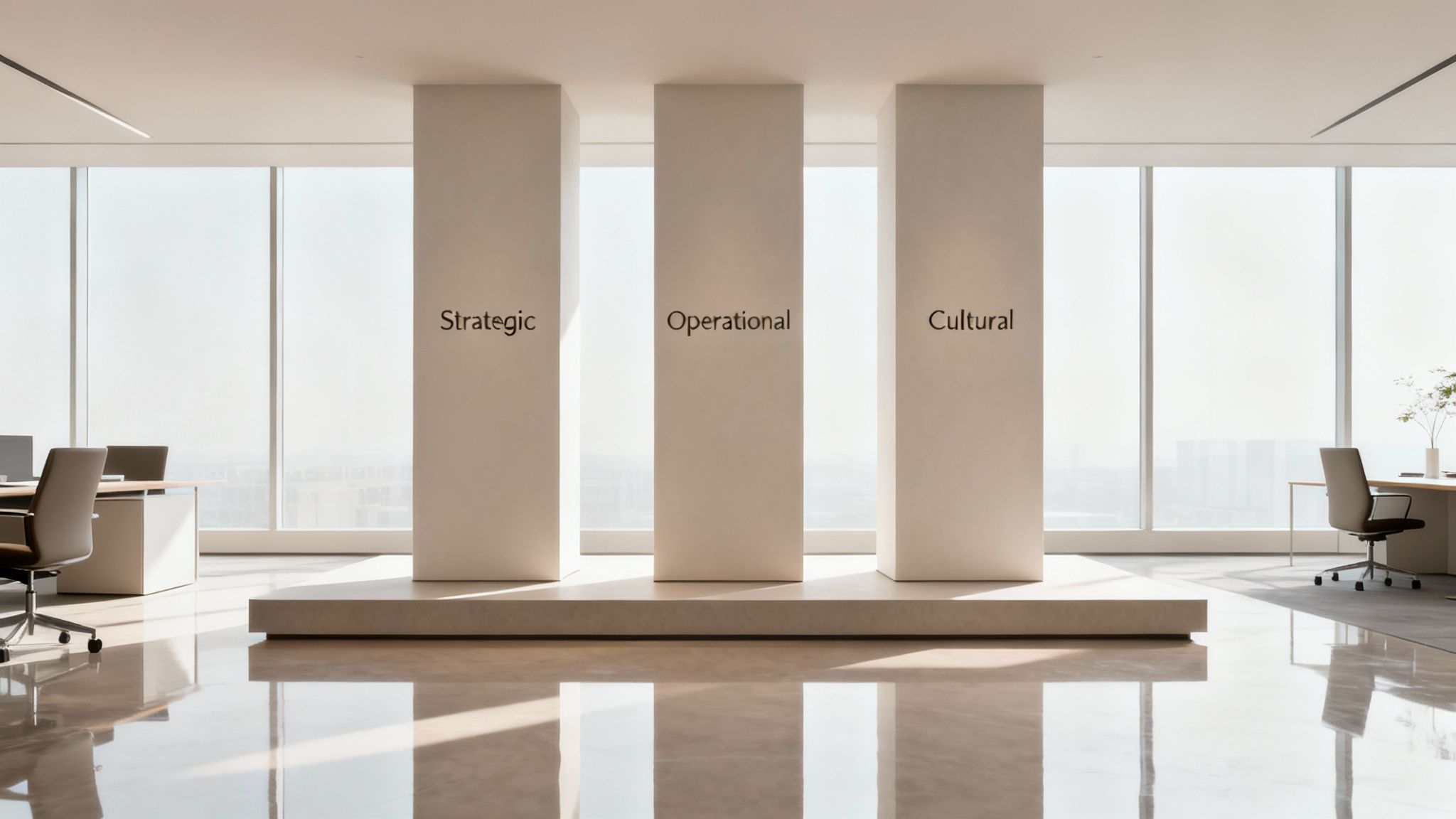
True alignment in business doesn’t happen by chance. It’s not about a single initiative or a motivational poster on the wall; it’s a living, breathing system built on a solid foundation. If you want to build an organisation where everyone is genuinely pulling in the same direction, you need to concentrate on three distinct but tightly connected pillars.
Think of these pillars as the core components that turn a big-picture vision into tangible, everyday action. When all three are strong and working in harmony, they create a powerful loop that builds momentum and sharpens focus across the entire company. Let’s break each one down.
1. Strategic Alignment: The Why
Strategic alignment is the bedrock. It’s all about making sure everyone, from the CEO down to the newest intern, understands the company’s North Star. This is the “why” behind all the work—the high-level vision, mission, and handful of priorities for the next one to three years.
Practical Example: A scale-up has an ambitious goal: “Become the UK market leader in B2B fintech solutions within two years.” That vision is the starting line. Strategic alignment translates that broad statement into clear, practical goals for each department.
- For the Product team: This means focusing the roadmap squarely on features that meet the UK market’s specific compliance rules and user needs.
- For the Marketing team: Their job is to build brand awareness and generate qualified leads specifically from UK-based financial institutions.
- For the Sales team: Their targets are directly linked to acquiring a set number of new UK customers.
Without this pillar, you get chaos. Departments end up creating their own conflicting priorities, pulling the company in different directions no matter how hard they work.
2. Operational Alignment: The How
While strategy defines why you’re heading somewhere, operational alignment defines how you’re actually going to get there—quarter by quarter, week by week. This is the pillar that connects the grand vision to the daily and weekly rhythms of your teams. It’s where high-level goals hit the ground and become real work.
Practical Example: Let’s go back to our fintech company's Product team. Their strategic goal is clear, but how does that show up in their bi-weekly sprints? Instead of chipping away at a dozen minor features, their sprint objective might be: "Release the beta version of the GDPR-compliant data handling module." This task isn't arbitrary; it’s a direct, measurable step towards the quarterly company objective of "Achieve product-market fit in the UK."
Learning Moment: Alignment transforms daily work from a series of disconnected tasks into a set of meaningful contributions. It gives every sprint, every project, and every meeting a clear and compelling purpose.
This connection makes it dead simple for teams to prioritise what’s important and see the immediate impact of their efforts on the company’s bigger picture.
3. Cultural Alignment: The Who
The final pillar, cultural alignment, is all about the shared values and behaviours that guide how work gets done. It’s the “who” we are as a company and how that identity shapes thousands of small decisions every single day. Culture is the invisible force field that keeps everyone on track.
Practical Example: Our fintech company has a core value of “Customer Obsession.” Cultural alignment is what makes sure this isn't just a hollow slogan on a wall.
- The Development team lives this value by prioritising bug fixes reported by early UK customers over building a new 'nice-to-have' feature.
- The Support team feels empowered to spend extra time with new clients to make their onboarding seamless, even if it messes with their call-time metrics.
- The Sales team actively listens to feedback from prospects about missing features and faithfully reports it back to Product, even if it means a longer sales cycle.
When your strategy, operations, and culture are all in sync, you create a truly aligned organisation. The strategy sets the direction, operations provide the roadmap, and culture guides everyone’s behaviour along the journey.
How to Spot Hidden Misalignment in Your Team
Misalignment rarely announces itself. It’s more like a creeping fog—a general sense of friction or sluggishness you can't quite put your finger on. But it isn't just a feeling; it's a real problem with clear, measurable symptoms. The trick is knowing where to look before those small disconnects snowball into major roadblocks.
Think of your company as an electrical circuit. When everything’s aligned, power flows seamlessly from the source (your strategy) to every team, lighting up your goals. Misalignment creates resistance and broken connections, causing the system to flicker, short-circuit, or fail completely. You need a practical way to find and fix these faults.
Performing an Alignment Health Check
The first step is to swap guesswork for diagnosis. A simple ‘Alignment Health Check’ helps you systematically hunt for the disconnects that are slowing you down. This isn’t about pointing fingers; it's about making the invisible visible so you can solve the right problems.
Here are three practical steps to get you started:
Trace the Goal: Pick one top-level company goal for the quarter. Start with how the executive team defines it, then follow its trail down through each department. Does the Head of Product describe it the same way as the CEO? Can a junior engineer explain how their current work connects to it? You’re listening for the point where the signal gets fuzzy, distorted, or breaks completely.
Audit Your Meetings: Dig into the notes from your last few cross-functional meetings. Look for the tell-tale signs of friction. Are teams using ‘us vs. them’ language? Do marketing and product talk about the same feature using totally different metrics for success? These verbal cues are often the earliest warning signs of departmental silos.
Survey for Clarity: Go beyond generic engagement surveys with a few targeted questions. Anonymously ask your team to rate their agreement with statements like, “I can clearly explain how my daily work impacts our customers” or “I understand our top three company priorities for this quarter.” The gap between what leadership assumes is clear and the reality on the ground can be shocking.
Learning Moment: The crucial insight here is realising that alignment isn’t an abstract concept. It’s a series of clear, traceable connections between strategy and execution. When those connections fray, so does your ability to perform.
This health check gives you a concrete starting point. Instead of just saying, “We feel misaligned,” you can now say, “Our engineering team can’t connect their work to our Q3 revenue goal, and that’s where we need to focus.”
Interpreting the Warning Signs in a Volatile World
Pinpointing these internal disconnects is even more critical when external pressures are high. Economic volatility can amplify even minor misalignments, turning them into serious strategic weaknesses. When the market is unpredictable, your team’s ability to move as one cohesive unit becomes your greatest competitive advantage.
Recent data shows just how widespread this challenge is. Economic uncertainty is the top concern for 36% of UK businesses with 10 or more employees, and only 20% of these firms report facing no challenges to their turnover. This points to a deep struggle to maintain strategic alignment in business while navigating a volatile environment. You can explore more data on business insights from the ONS to understand the full context.
Using OKRs as Your Alignment Framework
Now you can spot the warning signs of misalignment, it’s time to get a system in place that actively creates and sustains it. This is where a proven framework stops alignment in business being an abstract idea and turns it into a practical, repeatable process. One of the best tools for the job is OKRs (Objectives and Key Results).
Think of your company’s strategy as a destination on a map. If you don’t give people clear directions, every team will try to find its own way. You'll end up with detours, dead ends, and a lot of wasted fuel. OKRs act as your company-wide GPS, providing clear, turn-by-turn guidance that gets everyone on the most efficient route to the same destination.
Creating Your North Star with Company Objectives
Alignment always starts at the top. The leadership team needs to define a small handful of high-level Objectives for the entire company. These aren’t fluffy mission statements; they are ambitious, qualitative goals that paint a vivid picture of what success looks like over the next quarter.
A great company-level Objective acts as a rallying cry—a North Star that every single employee can look up to and navigate by.
Practical Example: A UK-based scale-up sets a powerful Objective: “Dominate the London Fintech Market.” It’s clear, inspirational, and sets an unmistakable direction. It instantly answers the question, “What’s our main focus right now?” for everyone in the business.
Cascading Alignment and Fostering Ownership
Once that North Star is set, the real magic of OKRs kicks in. Instead of a rigid, top-down cascade of instructions, teams are empowered to develop their own contributing OKRs. This is a crucial difference. The leadership team sets the destination, but each team gets to use its unique expertise to map its own route.
This process builds a deep sense of ownership and accountability.
- The Product Team might set an Objective to "Deliver a Killer Onboarding Experience for UK Customers."
- The Marketing Team’s Objective could be to "Become the Go-To Voice for UK Fintech Innovation."
- The Sales Team might aim to "Win Ten Marquee London-Based Clients."
Each of these objectives is distinct, but they all clearly and directly support the company’s main goal. They're like interconnected threads weaving together to form a strong, unified fabric.
Breaking Down Silos Through Radical Transparency
Perhaps the most powerful part of the OKR framework is its built-in transparency. Every team’s OKRs are public and visible to the whole organisation. This simple act systematically dismantles the silos that breed misalignment.
Practical Example: When the Product and Marketing teams can see each other’s priorities in real-time, their collaboration shifts from reactive to proactive.
Learning Moment: Marketing no longer has to guess what features are coming; they can see Product's Key Results and align their campaign calendar accordingly. Product can see Marketing's lead generation targets and understand the commercial pressure behind certain feature requests. This shared context is the antidote to "us vs. them" thinking.
This transparency creates a common language and a shared understanding of success, which is the foundation of genuine alignment. For more on this, you can explore how to achieve strategic alignment with OKRs in more detail.
This flowchart shows a simple process for finding out where your strategic goals might be breaking down.
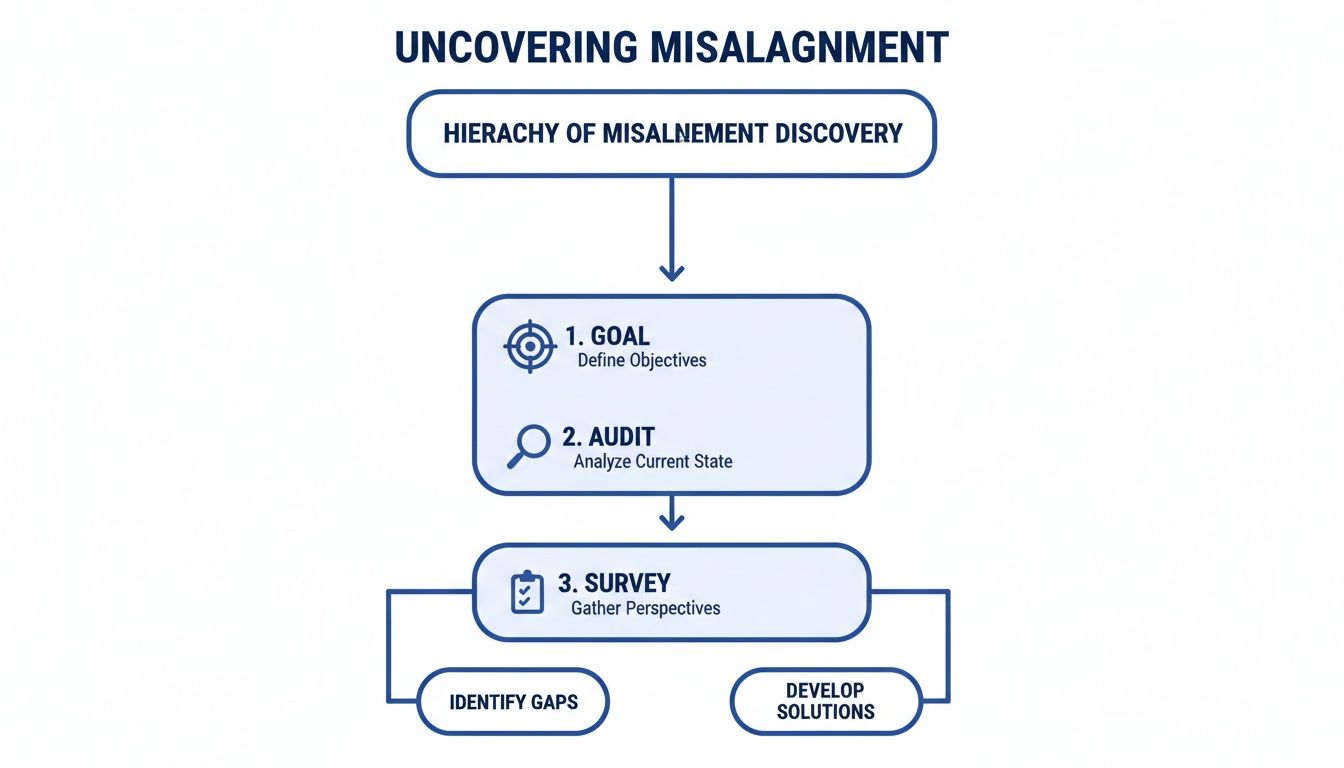
It shows how starting with a clear goal, auditing its translation through the organisation, and surveying your team's understanding are the core steps to finding alignment gaps.
A Practical Example of an OKR Cascade
To make this tangible, let's look at how a high-level goal translates into interconnected actions across a tech company.
Company Objective: Become the #1 Rated Project Management Tool for UK Creative Agencies
- Key Result 1: Achieve an average 4.8-star rating on Capterra from UK users.
- Key Result 2: Increase UK agency market share from 8% to 15%.
- Key Result 3: Secure positive reviews in three major UK creative industry publications.
This high-level goal then informs what individual teams work on:
| Team | Contributing Objective | Key Results |
|---|---|---|
| Product | Launch Features That Creatives Love | 1. Reduce project setup time by 40%. 2. Ship the top 3 most requested integration features. 3. Increase Daily Active Users from the creative sector by 25%. |
| Marketing | Drive UK Agency Demand and Awareness | 1. Generate 500 new MQLs from UK agencies. 2. Secure 15 product demos with target agencies. 3. Publish 4 case studies with UK agency clients. |
| Customer Success | Ensure New UK Agencies Succeed Wildly | 1. Achieve a 95% CSAT score for UK agency onboarding. 2. Reduce time-to-first-value to under 48 hours. 3. Proactively reach out to 100% of new agency clients in their first week. |
As you can see, the work of each team is distinct yet perfectly harmonised. The Customer Success team’s effort to improve satisfaction directly impacts the star rating (Company KR1), while Marketing’s lead generation efforts contribute directly to increasing market share (Company KR2). This is alignment in action.
Navigating Common Pitfalls That Erode Alignment
Getting everyone aligned feels like a huge win, but here’s the thing: the real work is just getting started. Alignment isn't a destination you arrive at. It’s a dynamic state that needs constant attention, like tending a garden. Even the best-laid plans can get derailed by predictable pitfalls that quietly creep into day-to-day work.
The challenge is keeping that focus sharp. Teams get swamped with daily tasks, urgent priorities pop up, and that initial clarity and energy can fade surprisingly fast. Knowing what traps to look out for is the first step in building a resilient system that keeps your momentum going.
The 'Set and Forget' Strategy
Probably the most common mistake is treating alignment as a one-off project. A company will launch its quarterly OKRs with a big, inspiring all-hands meeting, and then… crickets. The goals get filed away in a slide deck, only to be dusted off for the end-of-quarter review. This ‘set and forget’ approach is a guaranteed recipe for misalignment.
When your goals aren't part of the daily conversation, they become irrelevant. It’s only natural for people to drift back to old habits and focus on what feels most urgent right now, rather than what’s strategically important for the future.
Learning Moment: The only way to fix this is to weave your goals into the very fabric of your team's rhythm. Alignment isn't maintained in quarterly presentations; it’s reinforced in weekly check-ins, monthly progress reviews, and one-on-one conversations.
By making your goals a constant reference point, you keep them alive and top-of-mind. They stop being a static document and become a living guide for making better decisions every day.
Tying Compensation Directly to Goal Achievement
Another trap that seems logical on the surface is linking bonuses or performance ratings directly to hitting ambitious goals like OKRs. While you want to incentivise performance, this often backfires spectacularly. It encourages teams to play it safe.
When people feel their paycheque is on the line, they’re far less likely to set ambitious stretch goals. Instead, they’ll sandbag—setting targets they are 100% certain they can hit. This completely stifles innovation, discourages smart risk-taking, and turns an aspirational framework into little more than a glorified to-do list.
The key is to decouple aspirational goals from performance-based pay. Celebrate the progress, the learning, and the ambitious attempts—not just whether a target was hit. This fosters psychological safety, empowering teams to aim high without fearing a financial penalty if they fall short. For complex rollouts, many leaders find that bringing in outside expertise can help navigate these nuances. If you need support, you might be interested in learning about the five top reasons to hire an OKR consultancy.
Misalignment in Talent and Skills
Finally, you can have the sharpest strategy and the slickest framework in the world, but if you don't have the right people with the right skills to execute it, alignment will inevitably crumble. This is a massive issue for scaling product and technology organisations where specific expertise is non-negotiable. A talent gap is an alignment gap.
And this isn't a minor problem. Recruitment difficulties currently affect 29% of UK businesses with 10 or more employees. According to recent ONS data, half of these companies blame a lack of qualified applicants—a clear sign of the disconnect between strategic needs and the available talent pool. You can read the full ONS business insights survey for a closer look.
Avoiding these pitfalls isn't about luck; it's about being deliberate. The table below breaks down these common challenges and offers practical solutions to keep your team on track.
Common Alignment Pitfalls and How to Fix Them
| Common Pitfall | Why It Happens | Proven Solution |
|---|---|---|
| The 'Set and Forget' Mindset | Teams get busy with daily tasks, and strategic goals are forgotten until the end of the quarter. | Integrate goals into weekly team meetings and monthly reviews. Make progress visible on a shared dashboard. |
| Tying Pay Directly to OKRs | It seems logical to incentivise goals, but it encourages sandbagging and discourages ambitious targets. | Separate compensation from aspirational goals. Reward progress, learning, and smart risk-taking instead. |
| Ignoring Talent Gaps | Strategy is created without assessing if the team has the skills needed to deliver it. | Conduct regular skills audits against your strategic roadmap. Invest in proactive hiring and upskilling to close critical gaps. |
| Leadership Misalignment | Senior leaders have conflicting priorities or communicate different messages to their teams. | Dedicate time for the leadership team to align on a single set of company-level priorities before cascading them. |
| Fear of Failure | An organisational culture that punishes mistakes prevents teams from taking the risks needed for innovation. | Create psychological safety. Leaders should openly discuss their own failures and celebrate learnings from experiments that didn't work out. |
By anticipating these issues, you can build a strategic playbook to overcome them. This proactive approach is essential for sustaining alignment and ensuring your hard work creates lasting, meaningful change.
Your First Steps Toward Lasting Business Alignment
Turning the idea of business alignment into action can feel like a massive task, but it doesn't have to be. We've already covered why it's a strategic necessity and how frameworks like OKRs give you the structure to build it. Now, let's turn that knowledge into a practical plan you can start today.
Lasting change isn't born from a huge, disruptive overhaul. It comes from small, deliberate steps that build momentum and ripple across your organisation. This simple 30-day roadmap is designed to get you started without the overwhelm, focusing on diagnosis, direction, and a controlled pilot.
Your First 30 Days: An Action Plan
Think of this as your launch sequence. Each week builds on the last, laying a solid foundation for a more focused and synchronised organisation.
Week 1: Conduct Your Alignment Health Check
Before you can fix a problem, you have to understand its scale. Use the diagnostic tools we talked about earlier to get a real, data-backed picture of where your organisation stands.
- Trace a top-level goal: Follow it down through two or three departments. Where does the message get distorted, diluted, or just plain lost?
- Audit cross-functional meetings: Sit in and just listen. Can you hear the siloed language? Can you spot the conflicting priorities?
- Deploy a clarity survey: Ask pointed questions like, "Can you name our top three company priorities for this quarter?" and see what comes back.
The goal here isn't to find fault; it's to gather hard data. You're replacing that vague feeling of disconnect with specific, actionable insights.
Week 2: Workshop Your Top Priorities
Armed with your health check findings, get your leadership team in a room. The mission for this week is to forge crystal-clear alignment at the very top.
Learning Moment: A common mistake is simply assuming the leadership team is already aligned. Often, they have slightly different interpretations of the same goals. Forcing this conversation brings those differences to the surface so they can be resolved once and for all.
Dedicate a workshop to debating and agreeing on no more than three company-wide priorities for the coming quarter. These need to be clear, concise, and something everyone can actually get behind.
Weeks 3 & 4: Pilot Your First OKR Cycle
Now it's time to put the framework into practice, but in a small, manageable way. Instead of a "big bang" company-wide rollout, select one motivated and capable team to run a pilot OKR cycle. This could be a product squad, a marketing team, or an operations unit.
- Choose the right team: Pick a group that's genuinely open to new processes and whose work clearly links to one of the company priorities you just defined.
- Coach them through the process: Help them set a clear, ambitious Objective and a handful of measurable Key Results that directly support a company goal. To see what this looks like in practice, you can find a variety of helpful Objectives and Key Results examples to guide you.
- Learn and adapt: This pilot isn't about perfection; it's about learning. The insights you'll get from this small-scale test will be invaluable when you're ready for a wider implementation.
This simple, four-week plan transforms alignment from an abstract goal into a series of achievable steps. It builds momentum, creates early wins, and starts you on the journey toward a culture of clarity, focus, and shared purpose.
Frequently Asked Questions About Business Alignment
Even when you’ve nailed the strategy, a few practical questions always pop up when you’re introducing new ways of working. This final section tackles the most common queries I hear from leaders and teams about getting to—and staying in—a state of genuine alignment in business. Think of it as a quick reference to keep you moving forward with confidence.
How Often Should We Reassess Our Business Alignment?
Alignment isn’t a one-off project; it’s a living thing that needs a regular pulse check. You wouldn’t tune a guitar once and expect it to stay in perfect harmony forever, would you? The same goes for your organisation. It needs frequent, small adjustments.
The best approach is multi-layered:
- Strategic Alignment: Your big-picture company goals need a proper review once a year, with a lighter refresh every quarter to make sure you’re still responding to what the market is doing.
- Operational Alignment: This needs to move much faster. If you're using OKRs, this translates into weekly team check-ins and monthly reviews of your progress.
This constant rhythm stops the slow drift back into chaos and keeps your organisation sharp and responsive. It shifts alignment from a once-a-year event into a core business habit.
What Is the Difference Between Alignment and Agreement?
Getting this right is absolutely critical for building a healthy, innovative culture. When companies mix these two up, they either grind to a halt or fall into the trap of dangerous groupthink.
Agreement is when everyone thinks the same way. It might feel nice and harmonious, but it’s often a killer of healthy debate and creative problem-solving. It pressures people into nodding along, even when they have valid concerns.
Alignment, on the other hand, is when everyone commits to moving in the same direction, even if they disagreed on the path to get there. It creates space for passionate, honest debate during the planning stage. But once a decision is made, the entire team rows in the same direction with total focus.
Learning Moment: OKRs are a fantastic tool for building this "disagree and commit" culture. They make the chosen direction and priorities crystal clear and non-negotiable for the quarter. This ensures everyone pulls together, uniting the team without demanding uniformity.
Can a Small Business Be Aligned Without Using OKRs?
Yes, but only for a short time. In a tiny startup with just a handful of people, the founder’s vision is usually shared informally over a desk or a coffee. Everyone is so close to the action that alignment happens almost by osmosis.
The problem is, that informal system shatters the moment you start to scale. As soon as you grow beyond 15-20 people, you add layers of communication, multiple teams, and priorities that start pulling in different directions. What was once intuitive quickly becomes chaotic.
A formal framework like OKRs gives you the structure, transparency, and shared language needed to keep everyone on the same page as you grow. It turns alignment in business from something accidental and fragile into a process that is intentional and repeatable. For any scale-up with serious ambition, adopting a framework isn’t just a good idea—it’s essential for survival and success.
Ready to build unstoppable alignment in your organisation? The OKR Hub provides expert-led consulting, coaching, and training to embed OKRs into your company's DNA, driving clarity, focus, and measurable results. Learn more and start your journey at https://theokrhub.com.
Made with Outrank app
