

In today’s fast-moving environment, lots of organisations are brilliant at delivery, shipping projects, hitting milestones, keeping cost under control, and yet still struggle to prove they’re creating meaningful impact. That’s the heart of the outcome vs output problem: work gets managed as outputs (what we deliver) rather than outcomes (what changes as a result).
Outcome vs output: what’s the difference?
An output is the thing you deliver. An outcome is the change you create.
- Outputs are within your control (you can ship them).
- Outcomes are the why, whats different that makes life better for customers and colleagues.
Here’s a simple way to tell the difference:
| If it’s… | It usually sounds like… | Examples |
|---|---|---|
| Output | A deliverable, feature, project, or activity | “Launch the new onboarding flow”, “Migrate to the new platform”, “Deliver training to 300 people” |
| Outcome | A measurable change in behaviour, performance, or value | “Increase activation rate”, “Reduce time-to-serve”, “Improve customer retention”, “Reduce cost-to-serve without harming CX” |
If your reporting is dominated by on-time / on-budget / scope delivered, you’re mainly tracking outputs. That’s not wrong, it’s just incomplete. You can deliver perfectly and still miss the point.
Outcome vs output examples (delivery, cost, and value)
These are typical “output-heavy” statements and how to translate them into outcomes:
| Theme | Output (deliverable) | Outcome (measurable change) |
|---|---|---|
| Delivery / time | Deliver Project X by end of Q2 | Reduce customer wait time from X to Y |
| Product | Launch new onboarding flow | Increase activation rate from X% to Y% |
| Cost | Cut costs by 10% | Reduce cost-to-serve by 10% while keeping NPS at X+ |
| Process | Roll out new process to all teams | Reduce rework by X% / increase right-first-time to Y% |
| Features | Ship 12 new features | Increase weekly active usage of key journeys by X% |
| Service | Implement new support tooling | Reduce tickets in category A by Y% / reduce time-to-resolution from X to Y |
| Tech | Migrate to new platform | Improve uptime to 99.9% / reduce incident rate by X% |
| Training | Deliver training to 300 people | Increase capability score from X to Y / improve adoption to Y% |
This is where a lot of leadership teams get stuck: they can’t see value, so they default to “more delivery, faster”. When you can’t measure impact, speed becomes the proxy and it’s a risky one.
Having seen this many times with clients, we wanted to showcase the repercussions of prioritising delivery and costs over business outcomes and offer our insight into why a shift in mindset is necessary for organisations to thrive.
Below is a short clip where our OKR Associates discuss why teams get stuck in delivery and cost, and what changes when you shift from outcome vs output thinking towards value realisation. If you’re seeing lots of activity but limited impact, this is a useful lens before you move into OKR design.
Outcome vs output in practice: frontline disconnection to business strategy
Below the C-suite and department heads, teams often become focused on tasks, milestones, and delivery dates rather than the customer and business outcomes the work is meant to achieve. In outcome vs output terms, teams can end up “successful” on delivery while the organisation still fails to move the measures that matter.
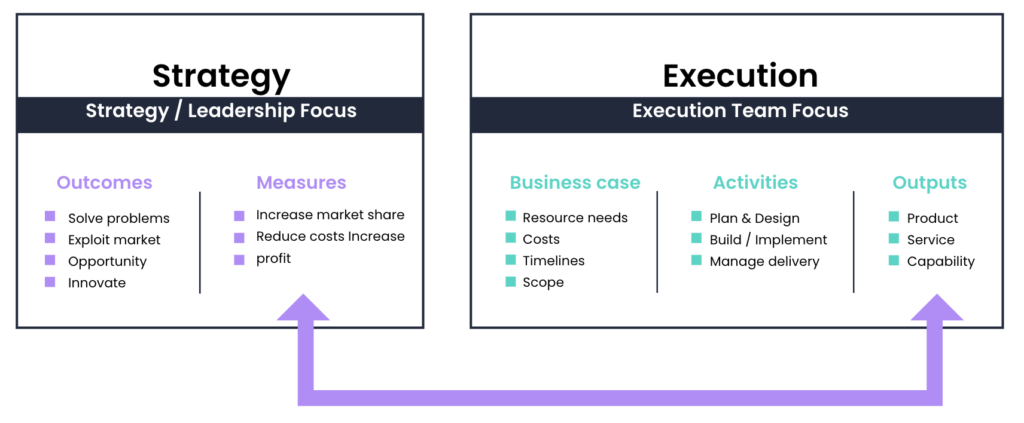
Leaders tend to communicate strategy using high-level operating metrics (for example, EBITDA) or long lists of KPIs that feel far removed from day-to-day delivery. I’ve seen organisations with hundreds of leadership KPIs and almost no clear line of sight from those measures to what delivery teams are doing week to week.
When that happens, the message teams receive is simple: deliver on time, keep costs down. Over time this drives a predictable pattern, less challenge, less innovation, and less ownership for outcomes because people can’t see how their work connects to meaningful impact.
The fix isn’t more reporting. It’s making outcomes explicit, translating them into a small set of measures teams can influence, and reviewing progress on value regularly (not just delivery status).
If this resonates, a practical next step is a short Leadership Workshop to:
- clarify the outcomes that matter most (customer + business)
- define a small set of measures you’ll actually track
- translate big priorities into outcome-led OKRs
- agree an operating rhythm for value review (not just delivery reporting)
Want to explore it? Connect with us today and we’ll suggest a simple, low-effort starting point.
https://theokrhub.com/booking-consultancy/
In the mean time continue reading:
Outcome vs output: when deliverables become the goal
Many change programs and initiatives are centred around delivering specific outputs or solutions, reinforcing the perception that the completion of tasks equates to achieving business outcomes.
However, this narrow focus on deliverables fails to capture the true impact of initiatives on the organisation.
Companies often fail to determine whether the delivered outputs actually generated the desired benefits or contributed towards business outcomes. This is the classic outcome vs output trap: finishing the work becomes the goal, rather than proving it created impact.
This is often due to the fact that senior management break down the outcomes into deliverables for the rest of the organisation to execute, and fail to communicate the outcomes that employees are expected to deliver for the organisation.
Traditional programs often operate on long time horizons and there is rarely a mechanism in place to track whether the intended outcomes are being delivered.
Businesses focus on tracking whether outputs are delivered on time and on budget, which further distances employees from the outcomes they’re expected to achieve.
The Need for Value Realisation
We’ve also identified that organisations we work with find it challenging to measure the impact of their initiatives.
Leaders are driven by a desire for speed and more deliverables, and thus frequently overlook whether these deliverables are creating business or customer value.
We go and sit down with the C-suite, we ask them questions, and what is it they say? “We want to go faster! We want more stuff, faster!”.
Part of the reason they want that is because they can’t measure the impact of what they have. So what is their natural response?
“If we’re not getting the outcomes we’re looking for, it must be because we’re not fast enough.”
But actually, it’s not delivery time, or delivery speed or what it is they’re doing that presents the problems, but the fact that they aren’t adapting the deliverables to maximise the value they deliver.
So, instead of emphasising the speed of delivery, organisations should prioritise understanding and measuring the value generated at regular intervals. Bringing outcome vs output into reporting forces the right question: what changed because we delivered this?
All of a sudden, providing quarterly updates on the value released by the organisation allows everyone to understand the purpose of their work and maximise the impact.
If this resonates with you why not set up a Leadership Workshop for your team to explore implementing OKRs and improving your opportunity to focus on Business Outcomes.
Shifting the Mindset
The fundamental problem lies in the bias ingrained from the start, where the solution itself is considered the answer.
When fixated on deliverables, organisations fail to articulate the impact they intend to make or the desired change in state.
For example, to execute on an idea, we wrap governance over it, in order to have confidence that we’re going to deliver it at pace.
What we then end up doing is creating statements of work, functional requirements and test scripts, all of which direct focus on the work, not the outcome.
We believe a crucial shift is needed to move away from a contractual mindset and adopt a hypothesis-driven approach.
One approach that we’ve had success with in organisations, both large and small, is Objectives & Key Results (OKRs). OKRs help because they operationalise outcome vs output thinking through measurable Key Results.
OKRs encourage an outcome-oriented culture, whereby organisations propose hypotheses rather than creating rigid contracts.
This shift in mindset and culture allows for more flexibility and acknowledges that outcomes cannot always be predetermined.
FAQs: outcome vs output
| FAQ | Answer |
|---|---|
| What is the difference between output and outcome? | An output is what you deliver (a thing). An outcome is the measurable change that happens because of it (an effect). |
| What are examples of outcomes vs outputs? | Outputs: “launch X”, “deliver Y”, “ship Z”. Outcomes: “increase adoption”, “reduce cycle time”, “improve retention”, “reduce cost-to-serve without reducing quality”. |
| How do OKRs help move from outputs to outcomes? | OKRs clarify the change you want (Objective) and the signals that prove it (Key Results). They reduce “task list” behaviour and make learning/adaptation part of delivery. |
| How do you measure business outcomes? | Pick a small set of measures linked to customer value and business performance (e.g., conversion, activation, retention, cycle time, quality, cost-to-serve, NPS). Review them on a regular cadence and adjust delivery based on what you learn. |
| What is value realisation? | Value realisation is proving that work delivered has created intended benefits — not just that it was completed. It links investment to measurable impact. |
If this has peaked your interest, reach out for a conversation today.
