
Setting objectives is about giving your business a sense of direction, a clear focus, and a repeatable path to getting things done. Without them, it’s all too easy for teams to work incredibly hard on things that, ultimately, don’t move the needle. The result? Wasted effort and stalled growth.
Why Every Business Needs a North Star
Imagine a ship sailing a vast ocean with no map and no destination in mind. It might be moving, but its journey is completely aimless. That’s what a business looks like without clear objectives it’s just drifting. The core reason why businesses set objectives is to transform that random motion into focused, forward momentum. They are the strategic signposts that guide every decision, from high-level planning right down to daily tasks.
This is the process that turns vague ambitions into tangible action. It’s the difference between saying, “we want to grow,” and setting a clear objective like, “Expand our market share in the North of England by 15% this year.” The first is a wish; the second is a plan.
In this guide, we’ll explore the essential pillars of effective objective setting, showing you how they create clarity and drive performance. We will cover how objectives:
- Build Strategic Alignment: Ensuring everyone is pulling in the same direction.
- Improve Focus and Prioritisation: Directing effort towards what truly matters.
- Drive Accountability: Creating clear ownership and measures of success.
- Boost Employee Motivation: Connecting individual work to the company’s mission.
Key Learning Moment: Objectives are not just a to-do list for management. They are a communication tool that translates the company’s vision into a shared language that every employee can understand and act upon.
Throughout this article, we’ll look at how modern frameworks like Objectives and Key Results (OKRs) make this process practical and powerful for today’s leaders and their teams. By setting the right objectives, you provide a North Star that guides your organisation through complex decisions, market shifts, and periods of rapid growth, ensuring every step taken is a step toward your ultimate destination.
Building Strategic Alignment and Focus
Objectives are the connective tissue that links a company’s grand vision to the daily grind. Without them, you get chaos.
Picture an orchestra where every musician is playing from a different sheet of music. It’s just noise. Clear objectives act as that single piece of sheet music everyone follows, turning individual effort into powerful harmony.
This is a core reason businesses set objectives in the first place. They break down silos and stop different departments from accidentally working against each other. When every single team understands exactly how their work contributes to the bigger picture, their efforts become coordinated. This shared understanding is the bedrock of strategic alignment, turning separate activities into a collective push towards the same destination.
The Power of Cascading Objectives
So, how do you build this alignment in practice? The most effective way is through cascading objectives.
This is where high-level company goals are systematically broken down into more specific objectives for each department, team, and sometimes even individual. It creates a crystal-clear line of sight from the boardroom right down to the frontline. For any growing business, getting this right is a game-changer.
Key Takeaway: Cascading objectives translates a company’s vision into actionable, interconnected goals for each team. It ensures every part of the business is not just busy, but busy working on the right things in a coordinated way.
Let’s take a scale-up with a big, ambitious company-wide objective:
- Company Objective: Become the recognised market leader in our industry this year.
That’s a powerful statement, but it’s far too broad for the product or sales teams to act on directly. Through cascading, this vision gets translated into specific, relevant missions that people can actually get their hands on.
This diagram shows how a primary goal is supported by key pillars like alignment and focus, which are essential for achieving success.
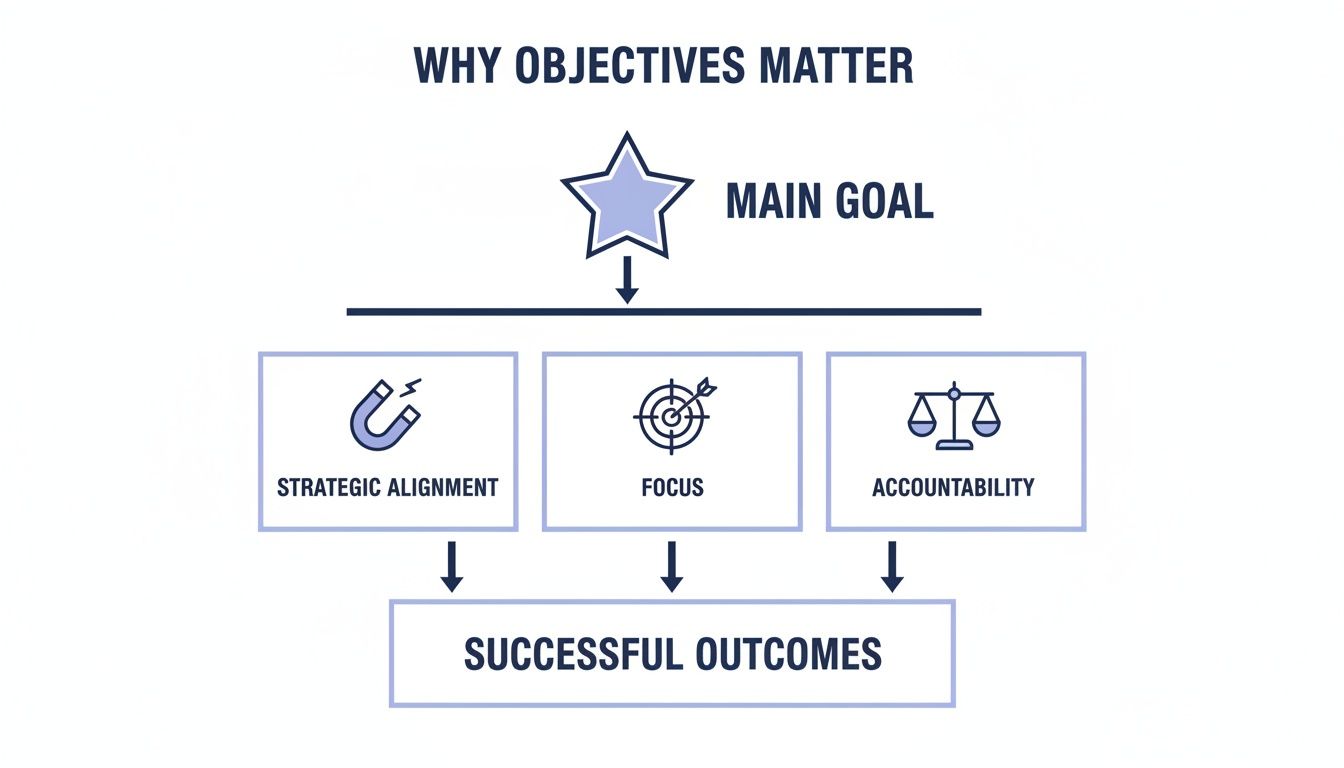
As you can see, those high-level goals have to be broken down into focused components to stand any chance of becoming a reality.
Cascading Objectives in Action
Let’s see how this works in a real-world scenario. That high-level goal of market leadership can be cascaded into tangible objectives that give different teams their marching orders:
- Product Team Objective: Launch a game-changing new feature set that competitors cannot match in the next six months.
- Marketing Team Objective: Capture 20% of the target market’s share of voice through strategic campaigns in Q3.
- Sales Team Objective: Increase new enterprise client deals by 30% over the next two quarters.
Suddenly, an abstract strategy becomes a concrete, unified plan. The product team knows their feature launch is critical for sales to hit their number. The marketing team understands their campaigns are designed to directly support the company’s growth targets.
Everyone can see their part in the larger story. That’s when you get real traction.
Driving Accountability and Measuring What Matters
Let’s be honest, one of the most powerful reasons to set objectives is to turn vague ambitions into something real—something you can actually measure. Without clear targets, success is just a matter of opinion, and it’s almost impossible to know if you’re truly making progress. It all comes back to a timeless principle: what gets measured gets managed.
Clear objectives create a transparent framework that fosters genuine accountability. When everyone knows exactly what the target is and how you’re tracking it, there’s no room for guesswork. This clarity doesn’t just hold people to account; it empowers them by giving them direct ownership over their results. The focus shifts from just being busy to delivering tangible value.
From Ambition to Action
This is exactly where frameworks like OKRs (Objectives and Key Results) come into their own. They provide a beautifully simple structure for creating that much-needed clarity. The Objective points you in a clear, qualitative direction, while the Key Results define precisely what success looks like in numbers.
This simple structure turns a lofty goal into a measurable mission. It gives teams a shared language to discuss progress, call out roadblocks, and, importantly, celebrate wins. This systematic approach is a game-changer for any organisation that’s serious about performance.
Just look at how the UK Statistics Authority operates. It uses a structured plan with clear, measurable objectives to ensure its teams deliver on national priorities, from publishing quality economic data to filling critical evidence gaps for the government. Their model proves how clear targets enable even massive, complex systems to respond effectively. You can dig into the full details of their strategic business plan for 2025-2026 on their official site.

A Practical Example for a Product Team
Let’s make this real. Imagine a product team has a goal to “improve the new user experience.” It sounds good, but it’s not actionable or measurable. How on earth do you know when you’ve succeeded?
By applying an objective-setting framework, this fuzzy goal becomes a powerful tool for accountability.
Objective: Launch a Seamless New User Onboarding Experience
This objective is inspiring and provides a clear direction. Now, we just need to add measurable key results to define what “seamless” actually means.
- Key Result 1: Increase the new user activation rate from 40% to 60% by the end of the quarter.
- Key Result 2: Reduce onboarding-related support tickets by 50% within 30 days of launch.
- Key Result 3: Achieve a user satisfaction score of 9/10 on the onboarding flow survey.
Suddenly, the entire team has a precise definition of what winning looks like. Everyone understands the mission, and progress can be tracked week by week. This is the crucial learning moment: accountability isn’t about assigning blame; it’s about creating shared clarity on what truly matters.
When you define success upfront, you empower your team to own the outcome. If you’re curious to see how this works for different teams, you might want to explore these Objectives and Key Results examples.
Optimizing Your Resource Allocation
Objectives are much more than just goals jotted down on a whiteboard; they’re a powerful filter for making tough strategic decisions. They tell leaders where to point their most finite and precious resources: time, money, and people. This is a huge part of why businesses set objectives in the first place—to make smarter choices, consistently.
When objectives are sharp and clear, it becomes so much easier for teams to say ‘no’ to distracting side projects and ‘yes’ to the work that truly pushes the company forward. This laser-focus stops resources from being spread too thin across a dozen different ventures, which is a classic trap for ambitious scale-ups.
The Prioritisation Learning Moment
Let’s make this real. Imagine a growing SaaS company sets a bold objective: “Capture the Enterprise Market this Year.” That single statement creates an instant learning moment for the entire business, showing everyone what prioritisation actually looks like in practice.
Suddenly, it’s crystal clear where the budget should flow. Instead of funding a scattergun of ideas, the path is obvious:
- Financial Investment: Funnel a serious chunk of the budget into building enterprise-grade security features.
- Talent Allocation: Put your best engineers on the enterprise integration team, not on minor bug fixes for the free plan.
- Marketing Focus: Shift spend from broad social media ads to account-based marketing campaigns targeting specific Fortune 500 companies.
This is how clear objectives stop wasted effort before it even starts. Every pound spent, every hour worked, and every person assigned is now directly tied to a defined, valuable outcome. Resource allocation shifts from a guessing game to a strategic exercise.
Investing with Purpose
You can see this disciplined approach playing out in the wider economy. UK business investment data shows that organisations with clear financial and growth objectives consistently pull ahead of the pack. Take Quarter 3 of 2025, for instance, where UK business investment shot up by 2.7% compared to the same period in 2024, driven heavily by investments in technology and intellectual property. This tells us that forward-thinking businesses are setting objectives that align with innovation, which allows them to compete far more effectively. You can find more details in the UK business investment findings from the ONS.
The data highlights a critical point: setting objectives isn’t just about planning. It’s about actively channelling your resources into the areas that will generate the biggest returns. It makes sure that your most valuable assets—your people and your capital—are always working on what really matters. Without that clarity, even the most talented teams can end up running on the spot, working hard but making very little meaningful progress towards the company’s ultimate vision.
Boosting Employee Engagement and Motivation

Let’s move beyond the spreadsheets and strategy decks. One of the most powerful reasons why businesses set objectives is their profound effect on people. Today’s employees, particularly in fast-moving product and tech teams, are driven by a deep need for purpose. They don’t just want a pay cheque; they want to see the real-world impact of their work.
Well-crafted objectives are the bridge connecting daily tasks to the company’s mission. They turn a to-do list into a meaningful contribution. When your work has a clear ‘why’, motivation tends to follow naturally.
Turning a Job Into a Mission
Imagine a junior marketer is tasked with writing five blog posts this week. Without context, it’s just content creation. But frame that work with a clear objective, and everything changes.
That same marketer suddenly understands their blogs directly support a team objective to “Increase Inbound Leads by 20% this Quarter.” Their perspective shifts immediately. They’re no longer just writing; they are actively generating the leads that will fuel the company’s growth. That direct line between effort and outcome is a huge motivator, fuelling both engagement and quality.
This is a key insight for leaders: clarity of purpose is a force multiplier for your team’s energy. Objectives transform a job into a mission.
Fostering Ownership and Autonomy
The real magic happens when you involve teams in setting their own objectives. Top-down mandates can feel like orders to be followed, breeding compliance rather than commitment. But when teams help craft their own goals, it cultivates a powerful sense of ownership.
Involving teams in the objective-setting process fosters a profound sense of ownership and autonomy—two of the biggest drivers of job satisfaction and performance. It shifts the dynamic from “what I have to do” to “what we want to achieve.”
This collaborative approach delivers some clear wins:
- Deeper Buy-in: People are far more committed to goals they helped create.
- Smarter Objectives: The people on the front line often have the sharpest insights into what’s achievable and what will actually move the needle.
- Greater Autonomy: It empowers teams to figure out how to hit the goal, which unleashes their creativity and problem-solving skills.
This sense of control and purpose is vital for keeping your best people. By connecting individual contributions to collective goals, objectives provide the meaning that people crave. This is a core responsibility for modern HR and people leaders who are focused on building a workplace culture where people can thrive.
Building Resilience and Managing Risk
In a volatile market, clear objectives are what keep your teams grounded. It’s an easily overlooked benefit, but a critical one. When everything outside the business feels chaotic, your goals act as an anchor, stopping teams from getting dragged into a purely reactive state every time something unexpected happens.
Think about it. When a new competitor suddenly appears or the market takes a sharp turn, companies with clear objectives can adjust their tactics without losing sight of the bigger picture. That stability is what lets them ride out storms that would otherwise throw them completely off course.
From Rigidity to Agility
Here’s the bit people often get wrong: objectives aren’t rigid constraints. They’re strategic guideposts. They give you the freedom to be agile while still making sure you’re moving forward. They tell you the destination, but they don’t dictate every single turn on the journey.
This empowers your teams to be creative and responsive. If the first plan isn’t working, the objective doesn’t change, but the team is free to pivot its approach. This is how you build genuine organisational resilience.
A well-set objective is like a ship’s rudder, not its engine. It doesn’t provide the power, but it makes sure all that power is directed toward the right destination, even when the seas get rough.
Take businesses with firm sustainability objectives, for example. They were far better prepared to handle recent supply chain shocks and shifting consumer attitudes. Why? Because their commitment to sustainability had already pushed them to build more diverse and resilient supply networks, long before it became a crisis for everyone else.
This isn’t a niche trend anymore; it’s firmly embedded in UK business strategy. By 2025, it’s expected that over 80% of UK small businesses will have integrated eco-friendly practices like cutting carbon footprints and ensuring ethical sourcing. These objectives help them meet consumer demand and navigate new regulations, like trade tariffs that force a rethink of supply chains. It just goes to show that setting forward-looking objectives, whether environmental or operational, leads to a much stronger position in the market. You can explore more on the biggest UK business trends shaping resilience on cdpinstitute.org.
Common Questions About Business Objectives
Even with a clear picture of why businesses set objectives, a few practical questions always pop up. Getting these details right can be the difference between a goal-setting framework that sticks and one that fizzles out.
Here are some straight answers to the most common queries I hear.
What Is the Difference Between an Objective and a KPI?
Think of it like this: an objective is your destination, while a KPI is like the fuel gauge on your car’s dashboard.
An objective is a broad, ambitious goal that describes what you want to achieve, like “Create an amazing customer experience.” It’s directional and inspiring.
A Key Performance Indicator (KPI), on the other hand, is a metric that tracks the ongoing health of the business—think “Monthly Website Uptime.” KPIs tell you if business-as-usual is on track. Objectives are there to drive a significant change or leap forward. Your key results will almost certainly move your KPIs, but they’re different tools for different jobs.
How Often Should We Review Our Objectives?
For most companies today, especially those in fast-moving industries, a quarterly rhythm is the sweet spot. This means setting fresh objectives every quarter and checking in on progress weekly or bi-weekly.
This cadence is just long enough to make real headway but short enough to stay agile and react to new market data or customer feedback. While big annual goals give you a North Star, quarterly objectives are what turn that vision into focused action, week in and week out.
Should Objectives Be Set for Individuals?
While you can do it, modern best practice—especially within frameworks like OKRs—strongly advises against setting objectives for individuals. It almost always leads to micromanagement and turns objectives into a glorified to-do list, completely stripping them of their strategic power.
Key Learning Moment: The most effective approach is to set objectives for the company and for teams. This sparks collaboration and empowers individuals to figure out their own contributions to the team’s shared goals, fostering genuine ownership and creativity.
Ready to stop drifting and start driving real results? The team at The OKR Hub provides expert consulting and training to help you embed a powerful objective-setting framework that sticks. Learn more about how we can help you achieve clarity and focus at https://theokrhub.com.
