
Ever feel like your company’s big vision is disconnected from what people do day to day? That gap is usually down to confusion between aims and objectives for business.
Your aim is the long-term destination, the direction you’re heading in. Your objectives are the measurable steps that prove you’re moving the right way. When organisations blur the two, teams stay busy, but progress becomes hard to see, hard to measure, and even harder to sustain.
Your Compass And Your Map: Understanding Aims And Objectives
Many businesses don’t fail because of a lack of ambition. They falter because there’s a huge disconnect between their grand vision and day-to-day actions. This is where getting crystal clear on your aims and objectives becomes a game-changer.
Think of it like planning a cross-country road trip.
Your aim is the final destination “Let’s drive to the Scottish Highlands for an amazing adventure.” It’s broad, exciting, and gives the whole journey its purpose. It answers the question, “Where are we ultimately trying to go?”
Your objectives, on the other hand, are the specific, actionable steps on your map. “Drive to Manchester by 3 PM,” “Refuel the car in Carlisle,” and “Arrive at the hotel in Inverness before 9 PM.” Objectives answer the question, “How will we know we’re on the right track?”
The Guiding Power Of A Business Aim
A business aim provides direction and inspiration. It’s your North Star, the thing that guides every major decision. For instance, a UK-based sustainable packaging company might have an aim like this:
“To become the UK’s most trusted provider of eco-friendly packaging solutions for e-commerce businesses.”
This statement is ambitious and carves out a clear position in the market. It doesn’t get into the nitty-gritty of how they’ll do it, but it rallies the entire organisation around a shared purpose. It’s the ‘why’ that keeps everyone motivated when things get tough. A strong aim aligns your teams and makes your company’s reason for being completely clear.
Turning Vision Into Action With Objectives
While an aim points you to the destination, objectives create the route. They are the concrete, measurable milestones that turn a big vision into a tangible plan.
For our sustainable packaging company, objectives would break down that big aim into manageable chunks:
- Secure 15 new enterprise clients in the North West by the end of Q3.
- Reduce production waste by 20% within the next 12 months.
- Achieve a customer satisfaction score of 95% in our annual client survey.
Notice how each of these is specific, measurable, and time-bound. They aren’t just vague tasks; they’re clear markers of progress. Hitting these objectives proves the company is actually moving closer to its overarching aim.
This is much easier to picture as a hierarchy. The big, inspiring aim sits right at the top, supported by the concrete objectives below it.
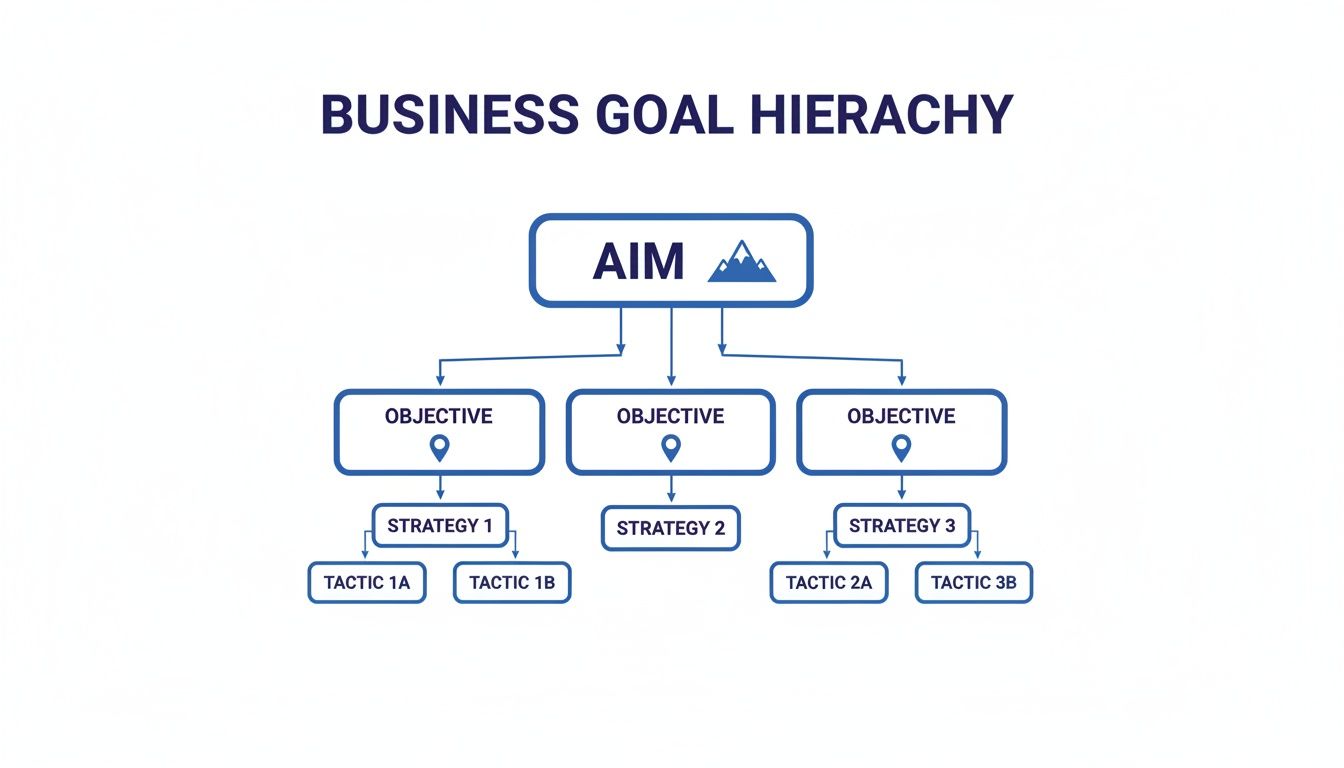
This visual makes it obvious that objectives aren’t just random goals. They’re the foundational pillars holding up the entire strategic aim.
Aims Vs Objectives At A Glance
To really nail the difference, this table breaks it down for you. Think of it as a quick cheat sheet for distinguishing your long-term vision from your short-term, measurable targets.
| Characteristic | Business Aim (The Destination) | Business Objective (The Route) |
|---|---|---|
| Timeframe | Long-term | Short-to-medium-term |
| Focus | The “what” and “why” – your overall purpose | The “how” – specific actions to be taken |
| Scope | Broad and overarching | Narrow and specific |
| Measurement | Abstract and hard to measure directly | Concrete, quantifiable, and measurable |
| Purpose | To inspire and provide direction | To track progress and ensure accountability |
| Example | “Become the market leader” | “Increase market share by 10% in 12 months” |
Ultimately, a clear aim gives you purpose, while well-defined objectives tell you if you’re making real progress.
Why You Need Both A Compass And A Map
At the end of the day, aims without objectives are just dreams. And objectives without a guiding aim can lead to a lot of busy work that has no real strategic impact.
You need the compass (your aim) to set the direction and the map (your objectives) to guide you step-by-step. This dual framework creates a powerful system that connects your long-term vision with short-term execution, ensuring every single action your business takes is a deliberate move toward its final destination.
Why Clear Goals Are Crucial For Modern UK Businesses

Trying to navigate today’s market without a clear destination is a fast way to burn through time, money, and energy. Defining a solid set of aims and objectives for business isn’t just a box-ticking exercise for a strategy away-day; it’s a survival tool for any modern UK company.
This discipline provides the focus needed to cut through the noise of daily operations and ever-shifting market demands. For scale-ups and established firms trying to grow in uncertain times, a well-defined aim acts as a filter. It helps leaders decide where to point their most precious resources. Without it, you risk teams pulling in different directions or chasing trends that don’t serve the bigger picture.
Building Resilience In A Dynamic Market
The UK business landscape is a perfect case study in why resilience is so vital. A primary aim for many is simply achieving sustainable growth against some pretty strong economic headwinds.
Government data shows there were 5.7 million private sector businesses at the start of the year, up a respectable 3.5% from the year before. But that growth came after a sharp 4.9% drop between 2020 and now, where the total number of businesses fell by 290,000. This volatility underlines the critical need for a clear objective: build resilience in the face of post-pandemic and Brexit-related turbulence.
Clear objectives are the very foundation of that resilience. They turn a broad, almost vague aim like ‘survive and thrive’ into tangible actions that build a tougher, more adaptable organisation.
By setting precise, measurable objectives, companies transform vague intentions into a clear plan of action. This fosters focus, improves team alignment, and drives a culture of accountability where everyone understands their contribution to the company’s success.
This structured approach is what empowers leaders to make sense of complex economic trends and translate them into clear, actionable priorities for their teams.
Focusing Resources For Maximum Impact
Imagine a company with a broad aim to “be more innovative.” It sounds great, but what does it actually mean? One team might think it means developing new products. Another might focus on optimising internal processes, and a third starts exploring AI. All valid ideas, but their disconnected efforts will lead to fragmented, lukewarm results.
Now, let’s look at that same company with specific objectives supporting that aim:
- Objective 1: Launch two new product features based on customer feedback by the end of Q3 to increase user retention by 15%.
- Objective 2: Automate 30% of manual back-office tasks by year-end to reduce operational costs by 20%.
- Objective 3: Implement an AI-powered customer support chatbot in Q4 to improve response times by 50%.
Suddenly, the fuzzy aim of “innovation” snaps into focus. It becomes a measurable strategy. Resources get allocated with real purpose, and every team knows exactly how their work connects to the company’s grand plan.
Aligning Your Teams For A Common Purpose
This kind of clarity is the secret sauce for organisational alignment—getting everyone rowing in the same direction. When objectives are clear and well-communicated, they cascade down through the company, creating a golden thread that connects an individual’s daily tasks all the way up to the highest-level strategic aims.
Having that shared understanding is incredibly powerful. You can learn more about creating these powerful connections with our guide to alignment in business.
Ultimately, clear aims and objectives aren’t about putting creativity in a box; they’re about channelling it effectively. They provide the guardrails that give teams the confidence to innovate and execute, knowing their efforts are adding up to a meaningful, shared goal. It’s this powerful combination of a clear destination (the aim) and a detailed roadmap (the objectives) that enables UK businesses to not just survive, but truly thrive.
How To Write Powerful Objectives That Drive Real Results
An objective without a clear metric is just a wish. Once you have your overarching aim sorted, the real work begins: crafting the specific, measurable objectives that will drag that vision into reality. This is where so many businesses stumble, writing vague statements that sound good in a meeting but give teams no real direction.
To write powerful objectives, you need to move beyond a simple to-do list. The most common mistake I see is teams focusing on outputs (the stuff you do) instead of outcomes (the results you create).
The Crucial Shift From Outputs To Outcomes
Let’s make this real. Imagine a product team at a software company. Their leader could set an objective like this:
- Output-focused objective: “Launch the new mobile app dashboard in Q1.”
This is just a task. It’s something the team will do. But it says absolutely nothing about the value it’s supposed to create for the business or the customer. Did the launch actually help? Who knows?
Now, let’s reframe this with an outcome in mind:
- Outcome-focused objective: “Increase active user engagement with the mobile app dashboard by 25% by the end of Q1.”
See the difference? It’s a complete game-changer. The focus is no longer on simply shipping a feature; it’s on the impact that feature has. This single shift forces your team to think critically about whether their work is actually moving the needle.
Learning Moment: This mindset shift is the single most important lesson in goal setting. It transforms your team’s focus from “what we did” to “what impact we created,” aligning their daily work directly with business value.
This approach ensures your efforts are always tied to measurable success. It stops teams from declaring victory just because a project is finished, pushing them instead to prove its worth with cold, hard data. For a deeper dive, our guide on OKR training offers more insight into goal setting and delivery.
A Practical Framework For Writing Strong Objectives
The well-known SMART framework is a decent starting point, but we can make it even more practical for today’s fast-moving teams. I’ve found that a strong business objective boils down to three core components.
- A Clear Action: Start with a verb that describes what you intend to do. Think Increase, Reduce, Improve, Achieve, or Secure.
- A Quantifiable Metric: This is the non-negotiable bit. You must include a number that defines what success looks like. This could be a percentage, a currency amount, or a specific count. No fluff.
- A Defined Timeline: Every objective needs a deadline. This creates urgency and gives everyone a clear point to review progress.
Let’s see this in action with a few examples.
Real-World Objective Templates
Here’s how different teams can use this framework to turn vague goals into objectives that actually mean something.
For a Sales Team:
- Vague Goal: “Sell more.”
- Powerful Objective: “Increase new enterprise client acquisition by 15% in the next six months.”
For a Product/Tech Team:
- Vague Goal: “Improve the website.”
- Powerful Objective: “Reduce the average page load time from 3.2 seconds to under 2 seconds by the end of Q2.”
For an HR/L&D Team:
- Vague Goal: “Improve employee training.”
- Powerful Objective: “Achieve an 85% completion rate for the new management training programme by year-end.”
Each of these revised objectives is sharp, concise, and leaves zero room for misinterpretation. They give teams a precise target to aim for and a clear benchmark to measure their performance against. This level of clarity is fundamental when setting aims and objectives for business success, as it gets rid of the guesswork and focuses everyone on a shared definition of what ‘done’ looks like.
Practical Examples of Aims and Objectives for Any Team
Theory is useful, but seeing aims and objectives for business in action is what makes the concepts click. To bring this to life, let’s walk through how these principles apply to specific roles and teams.
When you translate a high-level aim into a set of sharp, measurable objectives, you can see exactly how strategy connects to day-to-day work. These real-world illustrations should help you see how to apply this thinking to your own challenges straight away.

For The Scale-Up Founder
A founder’s world is a constant whirlwind of competing priorities, from fundraising to product development. A clear aim is the anchor needed to channel that energy where it counts most.
- Aim: Establish our company as the market leader in the UK fintech sector within three years.
This aim is bold and gives everyone a clear destination. It’s ambitious. But “market leader” is far too vague to act on by itself. To make it real, the founder needs to define what leadership actually looks like in measurable terms. That’s where objectives come in.
Breakdown into Objectives:
- Achieve £5 million in Annual Recurring Revenue (ARR) by the end of the fiscal year.
- Secure 30% market share among challenger banks within 24 months.
- Attain a Net Promoter Score (NPS) of +60 from our enterprise client base by Q4.
- Successfully close a Series B funding round of at least £15 million in the next 18 months.
Each objective provides a quantifiable target that directly supports the overarching aim of becoming the market leader. Now the team knows exactly what they’re chasing.
For The Product And Technology Team
Product and tech teams build the tools and experiences that deliver value to customers. Their aims are usually focused on user behaviour and satisfaction.
- Aim: Create a seamless and delightful user onboarding experience.
“Seamless and delightful” are great words, but they’re completely subjective. The team needs objectives to translate this qualitative aim into quantitative goals they can build, measure, and iterate on.
Breakdown into Objectives:
- Reduce the average time for a new user to complete setup from 8 minutes to under 3 minutes by the end of Q2.
- Increase the user activation rate (the percentage of new sign-ups who complete a key action) by 40% next quarter.
- Decrease user support tickets related to onboarding by 60% within six months.
- Achieve a user satisfaction (CSAT) score of 90% for the onboarding flow in post-setup surveys.
These objectives give the product team precise metrics to target, ensuring their development efforts are focused on creating a genuinely better user experience. For more detailed breakdowns like this, you might be interested in exploring a variety of Objectives and Key Results examples that show how different teams track success.
For The HR And People Leader
For an HR or People team, the focus is on building an environment where talent can thrive. Aims here are typically centred on culture, engagement, and retention.
- Aim: Foster a best-in-class employee experience to attract and retain top talent.
A “best-in-class” experience is a powerful aim, but it remains an abstract concept until it’s pinned down with hard data. The value of objectives is turning this ambition into a set of measurable commitments that hold the organisation accountable.
Breakdown into Objectives:
- Reduce voluntary staff turnover from 18% to below 10% within the next 12 months.
- Achieve a 90% employee satisfaction score in the next annual engagement survey.
- Increase the internal promotion rate for senior roles to 50% by year-end.
These examples show how any team, no matter its function, can connect its daily work to the company’s broader strategic direction. By breaking down ambitious aims into clear, measurable objectives, every team member understands exactly what success looks like and how their contribution helps achieve it.
Connecting Your Goals With The OKR Framework
Having well-crafted aims and objectives is a massive step forward, but it’s only half the battle. The real challenge is bringing them to life, making sure your strategy doesn’t just sit in a presentation deck gathering dust.
This is where the Objectives and Key Results (OKR) framework comes in. Think of it as the bridge between your high-level strategy and what your teams are actually doing, day in, day out. It’s what connects where you want to go with the quarterly execution needed to get you there.
Translating Aims and Objectives into OKRs
The beauty of the OKR framework is its simplicity. It takes the concepts you’ve already defined, your aims and objectives, and gives them a clear, actionable structure.
Here’s the key lightbulb moment:
Learning Moment: In the world of OKRs, your broad, inspirational business aim often becomes the Objective. Meanwhile, your specific, measurable business objectives evolve into the Key Results.
Let’s break that down a bit more.
- Objective (The ‘What’): This is your ambitious, qualitative goal. It answers the question, “What do we want to achieve?” It should feel aspirational and connect directly to your high-level business aim.
- Key Results (The ‘How’): These are the measurable, quantitative outcomes that prove you’re making progress. They have to be specific, time-bound, and completely unambiguous. You either hit the number, or you don’t.
Let’s go back to our HR leader whose aim was to “Foster a best-in-class employee experience.” Here’s how that translates into a powerful OKR for the next quarter.
- Objective: Create an unrivalled employee experience to attract and retain top talent.
- Key Results:
- KR1: Reduce voluntary staff turnover from 5% to 3% this quarter.
- KR2: Achieve an employee Net Promoter Score (eNPS) of +50 in the Q3 pulse survey.
- KR3: Increase the internal promotion rate for senior roles from 10% to 15%.
Suddenly, a vague aim is a focused, measurable plan for the next 90 days. The team has absolute clarity on what success looks like.
Driving Alignment And Data-Informed Decisions
A well-run OKR system does more than just track progress; it drives alignment from the C-suite right down to the front line. When company-level OKRs are set, teams can create their own, ensuring everyone is pulling in the same direction. This creates a transparent cascade of purpose throughout the whole organisation.
More importantly, this approach forces a critical shift from outputs to outcomes. Instead of focusing on tasks (“we launched the new survey”), teams focus on moving the needle on their Key Results (“we improved our eNPS score”). It empowers them to ask the right questions. If a project isn’t contributing to a Key Result, the team is empowered to challenge its value.
This relentless focus on measurable outcomes is crucial for UK businesses aiming to stay competitive. For scale-up founders, using frameworks like OKRs is essential for prioritising the initiatives that will actually deliver results. As a recent analysis by TheCityUK highlighted, a core objective for UK firms is to use data for faster, evidence-based decisions. You can read more about these strategic priorities and their key outcomes.
Ultimately, OKRs are the engine that drives your strategy forward. They provide the rhythm, accountability, and transparency needed to turn your aims and objectives into real, measurable business impact, quarter after quarter.
Common Goal Setting Mistakes And How To Avoid Them

Defining your aims and objectives for business is a critical first step, but the path is littered with common traps that can derail even the best-laid plans. Knowing what these mistakes are—and how to sidestep them—is the difference between a goal-setting culture that delivers and one that just goes through the motions.
Too many organisations treat goal setting as a one-off event, a box to tick at the start of the quarter. Let’s dig into the most common errors I see and talk about how to fix them with some practical, real-world adjustments.
Mistake 1 Confusing Tasks With Outcomes
This is probably the biggest and most common error I come across: teams creating objectives that are just a glorified to-do list. The focus lands squarely on what they will do (the outputs) instead of the results they will create (the outcomes).
The Mistake in Action: A marketing team sets an objective to “Launch a new social media campaign on three platforms.” They launch it, tick the box, and call it a success… even if it didn’t generate a single lead.
How to Fix It: Frame every objective around the impact you want to make. That same team’s objective should be something like: “Increase qualified marketing leads from social media by 25% in Q3.” This simple shift forces them to think about results, not just activity.
Mistake 2 Setting Too Many Objectives
When everything is a priority, nothing is. It’s a classic trap for ambitious leaders. They overload their teams with too many objectives, which dilutes focus, drains energy, and pretty much guarantees that nothing gets done with any real excellence.
Learning Moment: Goal setting is as much about choosing what not to do as it is about deciding what to pursue. A small number of well-chosen objectives will always have a greater impact than a long list of competing priorities.
For instance, a scale-up trying to “Increase revenue, expand to a new market, redesign the website, and improve customer support all in one quarter” is just setting itself up to fail.
- How to Fix It: You have to be ruthless with prioritisation. Limit each team to no more than three to five objectives per cycle. This forces the tough, but essential, conversations about what really matters most right now and ensures your resources are concentrated where they’ll have the biggest impact.
Mistake 3 Creating ‘Set and Forget’ Goals
Another common failure is the “set and forget” approach. Objectives are carefully hammered out at the start of the year, filed away in a shared drive, and not looked at again until it’s time to set the next batch.
This lack of follow-up makes the goals completely irrelevant to daily work. Without regular check-ins, teams lose their connection to the objectives, and there’s no chance to adapt if the ground shifts beneath their feet.
- How to Fix It: Make goal review a consistent ritual. Implement weekly or bi-weekly check-ins where teams can briefly discuss progress, flag obstacles, and confirm their work is still pointing in the right direction. This transforms goals from a static document into a dynamic guide for decision-making, keeping them alive, relevant, and at the centre of everything you do.
Your Questions Answered: Aims vs Objectives
To help you sharpen up your own strategic planning, I’ve pulled together answers to the questions that come up time and time again when I’m working with leadership teams on their aims and objectives for business.
What Is The Main Aim Of A Business?
While it can feel like there are a million different answers, it nearly always boils down to one thing: profitable and sustainable growth. This is the engine that allows a business to keep running, invest in its future, and deliver real value to its customers and stakeholders.
Profitability is a serious focus for UK businesses right now. Out of 5.45 million SMEs—which make up a staggering 99.16% of all businesses—a healthy 67% reported profits in the last quarter of last year. That’s a solid jump from 61% earlier in the year, showing things are stabilising after the cost-of-living crunch. You can dig into more of these UK business statistics if you’re curious.
How Many Objectives Should A Business Have?
There’s no magic number here, but less is definitely more. One of the most common mistakes I see is teams setting far too many objectives at once. It dilutes everyone’s effort and pretty much guarantees that nothing gets done well.
As a rule of thumb, try to limit each team or department to just three to five key objectives per quarter. This forces you to have the tough conversations about what really matters and gets everyone pulling in the same direction.
How Often Should We Review Our Aims and Objectives?
Aims are your North Star—they’re long-term. You should probably check in on them annually, or perhaps if there’s a major shift in your market. Objectives, on the other hand, need a much faster rhythm.
The classic “set and forget” approach to goals just doesn’t work. To keep objectives front and centre, they need to be reviewed regularly. A simple weekly or bi-weekly check-in is incredibly effective. It keeps them relevant and lets teams adjust their approach based on what’s actually happening, turning your objectives from a static document into a dynamic guide for making better decisions.
Can An Aim Change Over Time?
Absolutely. And it should! Your aims aren’t carved in stone. As your business grows, as markets change, or as completely new opportunities pop up, your long-term direction might need to shift.
Think about a tech start-up. Its initial aim might be all about achieving product-market fit. Once that’s nailed, the aim could naturally evolve to capturing a specific slice of the market or expanding into a new country. The key is that any change should be a deliberate, strategic decision—not just a knee-jerk reaction to short-term pressure.
If you want to turn big aims into measurable progress (without creating a giant KPI spreadsheet), we can help. Book a short call and we’ll show you how to translate your strategy into a small set of outcomes your teams can actually deliver using OKRs and a practical operating rhythm. Take a look at our expert-led OKR services and training at https://theokrhub.com.
