
Objectives and Key Results (OKRs) are more than just a popular framework; they are a powerful tool for aligning your teams, focusing effort, and driving measurable outcomes. The primary challenge for leaders isn’t understanding the theory, it’s mastering the practical application. Many struggle to translate ambitious strategic goals into the concrete, quantifiable key results that actually move the needle.
This guide bridges that gap, moving beyond abstract concepts to provide a curated library of practical, battle-tested objectives and key results examples. Each one is specifically designed for the unique challenges faced by high-growth scale-ups and established organisations seeking greater agility. We will explore ten distinct strategic goals, from launching a product to market leadership to scaling a high-performance culture.
Think of each example not just as a template, but as a mini-playbook. We will dissect the strategy behind each objective, offer actionable tactics for implementing the key results, and highlight common anti-patterns to avoid. You will leave with a clear blueprint for crafting OKRs that genuinely work for your teams and your business.
Our goal is simple: to provide you with insightful, valuable models that ensure your teams are not just busy, but are productively engaged in driving the business forward. Let’s move from theory to tangible impact.
1. Launch Product to Market Leadership – SaaS Growth
This foundational OKR is designed for ambitious scale-ups aiming to transition from a promising product to a dominant market force. It’s a strategic framework for concentrating company-wide efforts on achieving category leadership. The objective is aspirational and directional, while the key results provide a balanced scorecard, measuring user growth, customer loyalty, financial health, and brand influence. This is one of the most powerful objectives and key results examples for a company at a critical growth inflection point.

Strategic Breakdown
Let’s analyse a real-world inspired example to see how this works in practice.
Objective: Establish Figma as the leader in collaborative design tools.
- Key Result 1: Grow monthly active users (MAU) from 4M to 8M.
- Key Result 2: Increase customer retention rate (from annual churn) to over 85%.
- Key Result 3: Achieve the £40M ARR (Annual Recurring Revenue) milestone.
- Key Result 4: Reach 80% brand awareness among target design professionals.
This structure is effective because it creates healthy tension between its goals. Aggressively pursuing MAU growth (KR1) without focusing on retention (KR2) could lead to a leaky bucket problem, where new users sign up but don’t stick around. Similarly, hitting the ARR target (KR3) is balanced by the need for strong brand equity (KR4), preventing a “growth at all costs” mentality that could damage long-term positioning. This integrated approach ensures sustainable, high-quality growth.
Key Insight: A world-class OKR for market leadership isn’t just about growth; it’s about balanced growth. It pairs quantitative metrics (like revenue and user numbers) with qualitative ones (like retention and brand awareness) to build a resilient, category-defining business.
Actionable Takeaways
To implement this OKR effectively, leaders should:
- Define Leadership: Clarify what “market leadership” means for your specific niche. Is it the highest revenue, the largest user base, or the most recognised brand? This definition must be clear before cascading OKRs to departments.
- Use Leading and Lagging Indicators: While ARR is a critical lagging indicator of past success, incorporate leading indicators like new trial sign-ups or demo requests into team-level KRs to provide an early view of progress.
- Align Incentives: Ensure that sales, marketing, and product team incentives are aligned with these key results. If a sales team’s compensation is tied only to new revenue, they may neglect the customer success hand-off crucial for retention.
For product and revenue leaders looking to build this kind of strategic alignment, exploring
2. Enhance Product Velocity & Engineering Excellence
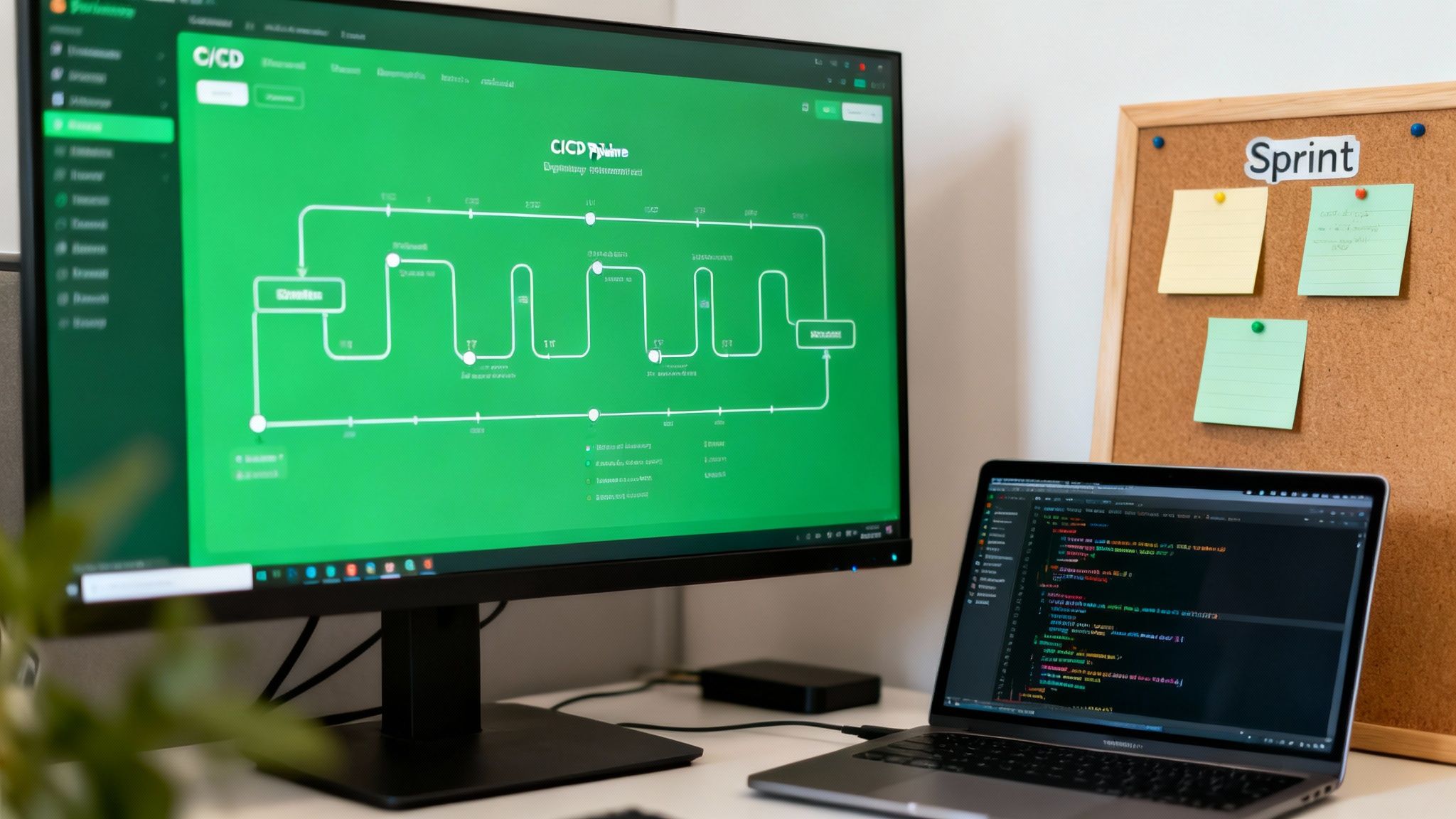
This OKR is for technology teams aiming to accelerate delivery speed without sacrificing quality. It is designed to help organisations move from chaotic, reactive development cycles to a state of sustainable engineering excellence. The objective is aspirational, focusing on becoming a high-performing engineering function, while the key results create a balanced system that measures speed, stability, code health, and team morale. This is one of the most critical objectives and key results examples for a tech-driven company looking to scale its product development capabilities effectively.
Strategic Breakdown
Let’s analyse a real-world inspired example, popularised by research from DORA (DevOps Research and Assessment), to see this in practice.
Objective: Enable rapid, reliable product delivery with engineering excellence.
- Key Result 1: Reduce average deployment cycle time from 2 weeks to 3 days.
- Key Result 2: Increase test coverage from 65% to 85%.
- Key Result 3: Reduce production incidents causing downtime by 50%.
- Key Result 4: Complete 70% of technical debt reduction initiatives on backlog.
This structure is powerful because it addresses the inherent tension between speed and stability. Pushing solely to reduce cycle time (KR1) could lead to rushed, low-quality code. However, this is counteracted by the need to increase test coverage (KR2) and reduce production incidents (KR3), forcing a focus on quality. Furthermore, the explicit goal to reduce technical debt (KR4) ensures the team is investing in long-term health, not just short-term feature delivery. This holistic approach prevents burnout and builds a resilient, high-performing engineering culture.
Key Insight: Elite engineering performance isn’t about just shipping features faster. It’s about building a system where speed, stability, and quality are mutually reinforcing. Measuring across these dimensions, from cycle time to developer satisfaction, creates a true picture of engineering health.
Actionable Takeaways
To implement this OKR effectively, engineering leaders should:
- Adopt DORA Metrics: Ground your key results in the four key DORA metrics: deployment frequency, lead time for changes, change failure rate, and time to restore service. These are industry-standard indicators of high-performing teams.
- Protect Capacity for Tech Debt: Formally allocate a percentage of each sprint (e.g., 20%) to address technical debt. This makes it a non-negotiable part of the development cycle, rather than an afterthought that is constantly deprioritised.
- Align with Product Teams: Share these engineering excellence OKRs transparently with product management. Help them understand that investing in reducing cycle time and tech debt is not a “tax” on features but a direct enabler of future product velocity.
3. Transform Customer Experience & Increase NPS
This customer-centric OKR is engineered for organisations aiming to build a moat around their business through loyalty and advocacy. It directly connects product and service improvements to customer perception, making it an essential framework for scale-ups transitioning from product-market fit to true category leadership. The objective sets a clear, aspirational goal of delighting users, while the key results provide a measurable, multi-faceted view of success, covering satisfaction, efficiency, adoption, and retention.

Strategic Breakdown
Let’s explore a practical example inspired by customer-obsessed companies like HubSpot or Slack.
Objective: Delight customers and establish an industry-leading experience.
- Key Result 1: Increase Net Promoter Score (NPS) from 42 to 65.
- Key Result 2: Reduce average customer support response time from 24h to 4h.
- Key Result 3: Improve product onboarding completion rate to 80% (from 55%).
- Key Result 4: Reduce customer churn rate by 30% (from 8% to 5.6% annually).
This OKR works because it creates a system of accountability for the entire customer journey. A high NPS (KR1) is a lagging indicator of a great experience, but it’s supported by leading indicators like faster support (KR2) and better onboarding (KR3). These operational improvements directly impact whether customers stay or leave, making the churn reduction target (KR4) a natural outcome of success in the other areas. This structure forces teams to look beyond surface-level satisfaction metrics and address the root causes of customer friction.
Key Insight: A powerful customer experience OKR treats satisfaction not as a vague goal but as a direct result of specific, measurable operational improvements. It connects the dots between what you do (e.g., respond faster) and how customers feel (e.g., higher NPS).
Actionable Takeaways
To use this OKR effectively, your teams should:
- Segment Your Data: Don’t treat NPS as a single number. Segment it by customer cohort (new, expansion, at-risk) to uncover specific patterns. New customers might struggle with onboarding, while legacy customers may have issues with new features.
- Map Pain Points to the Roadmap: Conduct regular customer interviews, especially with detractors, to understand the “why” behind their scores. Create detailed workflows to address their pain points and link these solutions directly to the product roadmap.
- Use Leading Indicators: While NPS is valuable, it reflects past experiences. Use leading indicators like Customer Effort Score (CES) or feature adoption rates in team-level KRs to track real-time progress towards a better experience.
4. Scale Organisation & Build High-Performance Culture
This people-focused OKR is critical for scale-ups navigating rapid growth while maintaining a cohesive company culture. It provides a strategic framework for balancing aggressive hiring with the essential work of improving retention, engagement, and leadership. This objective is indispensable for HR leaders and founders aiming to build a sustainable, scalable organisation where culture is a competitive advantage, making it one of the most vital objectives and key results examples for any high-growth company.
Strategic Breakdown
Let’s analyse a real-world inspired example to see how this works in practice.
Objective: Build a world-class, high-performance team that scales with our mission.
- Key Result 1: Grow headcount from 80 to 130 team members with a 90%+ onboarding success rate.
- Key Result 2: Achieve an 85%+ eNPS (employee Net Promoter Score) and reduce annual attrition to below 15%.
- Key Result 3: Complete a leadership development programme for 100% of managers.
- Key Result 4: Reach 40% female representation in leadership roles.
- Key Result 5: Establish an internal mobility programme with 20% of team members promoted or moving roles internally.
This OKR structure effectively manages the tensions inherent in scaling. Simply hiring fast (KR1) without focusing on employee satisfaction (KR2) and manager quality (KR3) creates a revolving door. The inclusion of diversity goals (KR4) and internal progression paths (KR5) ensures growth is not just about numbers, but about building a resilient and equitable organisation for the long term. It transforms HR from a reactive function into a strategic driver of business value.
Key Insight: A powerful People OKR moves beyond vanity metrics like headcount. It integrates growth targets with qualitative measures of culture, engagement, and leadership capability, ensuring the organisation’s human infrastructure scales as robustly as its revenue.
Actionable Takeaways
To implement this OKR effectively, leaders should:
- Define Culture Quantitatively: Translate abstract cultural values into measurable behaviours. If “collaboration” is a value, measure it through cross-functional project success rates or 360-degree feedback scores in team-level KRs.
- Invest in Manager Capability: Manager quality is the leading indicator of retention and engagement. Prioritise funding and time for manager training, coaching, and support systems before embarking on an aggressive hiring plan.
- Make Diversity a CEO Priority: Position diversity and inclusion goals as a company-wide strategic objective, not just an HR initiative. The CEO and executive team must visibly champion and be accountable for progress.
5. Expand Market Presence & Enter New Geographies
This strategic growth OKR is crafted for scale-ups that have achieved product-market fit in their home territory and are ready for international expansion. It provides a robust framework for managing the complexities of entering new geographies, ensuring that aggressive growth targets are balanced with operational readiness and deep market understanding. This is one of the most critical objectives and key results examples for businesses transitioning from a national champion to a global player.
Strategic Breakdown
Let’s analyse a real-world inspired example to see how a company like Wise (formerly TransferWise) might structure its European expansion.
Objective: Establish a strong presence in three core European markets while maintaining UK market dominance.
- Key Result 1: Launch operations in Germany and France with a localised product by Q2, achieving 500+ new business customers in each.
- Key Result 2: Hire country leads and build regional teams totalling 25+ people across new markets.
- Key Result 3: Achieve €2M ARR in new European markets (combined).
- Key Result 4: Establish partnerships with 8+ regional channel partners and integrations.
- Key Result 5: Achieve 70%+ product localisation (language, compliance, features) for all target markets.
This structure excels by forcing a holistic approach. Simply launching a product (KR1) without local expertise (KR2) or deep localisation (KR5) is a recipe for failure. The financial goal (KR3) is directly dependent on building the right local ecosystem through partnerships (KR4) and hiring. This prevents a common pitfall: treating expansion as a simple translation exercise rather than a comprehensive market-entry strategy.
Key Insight: Successful geographic expansion isn’t about planting a flag; it’s about planting roots. Your OKR must balance top-line growth metrics (ARR, customer numbers) with foundational, operational metrics (hiring local talent, product localisation, regulatory compliance) to build a sustainable presence.
Actionable Takeaways
To implement this OKR effectively, leaders should:
- Prioritise Localisation: Go beyond language translation. Investigate local payment preferences, regulatory hurdles, and cultural nuances. A dedicated “product localisation” key result (like KR5) makes this a measurable priority.
- Hire Local Leaders First: Do not wait to hire experienced country leads. Their local knowledge is invaluable for navigating the market, building a team, and adapting the global strategy to regional realities. Make this a leading KR.
- Create Regional P&Ls: Establish dedicated profit and loss statements for each new market. This provides clear financial accountability and helps measure the true return on investment for each expansion effort, informing future decisions.
6. Deliver Data-Driven Decision Making & Analytics Maturity
This capability-building OKR is increasingly critical for modern organisations aiming to transition from intuition-led to evidence-based operations. It focuses on establishing robust data infrastructure, analytics practices, and insight generation to inform strategic decisions. This framework is particularly relevant for scale-ups needing to mature their processes and for transformation leads implementing structured methodologies to improve business intelligence. This is one of the most vital objectives and key results examples for building a sustainable, high-performance culture.
Strategic Breakdown
Let’s analyse a real-world inspired example to see how this works in practice.
Objective: Enable data-informed decision making across all teams through analytics maturity.
- Key Result 1: Implement a unified data platform with dashboards accessible to 100% of relevant teams.
- Key Result 2: Reduce time-to-insight from 3 weeks to 2 days for standard business questions.
- Key Result 3: Train 100% of managers on reading and interpreting key metrics; achieve 80%+ weekly dashboard engagement.
- Key Result 4: Establish a data governance framework, achieving a 95% data accuracy rate for critical metrics.
This structure is effective because it moves beyond just building infrastructure (KR1) to measuring its actual impact and adoption. Simply providing access to data is not enough; the OKR ensures the data is fast (KR2), understood (KR3), and trustworthy (KR4). The tension between speed (KR2) and accuracy (KR4) forces a pragmatic approach to data governance, preventing a slow, overly bureaucratic process while maintaining reliability. The focus on training and engagement (KR3) directly addresses the common failure point of data initiatives: low user adoption.
Key Insight: True data maturity isn’t about having the most data; it’s about making quality data usable, accessible, and trusted. This OKR correctly frames the goal as a cultural and operational shift, not just a technical project.
Actionable Takeaways
To implement this OKR effectively, leaders should:
- Start with Critical Questions: Before building expansive dashboards, identify the top 5-10 business questions that teams need answers to. Build the initial infrastructure and reporting around answering these questions to demonstrate immediate value.
- Embed Analytics Talent: Don’t silo your data team. Embed data analysts or scientists within product, marketing, and sales teams. This proximity fosters collaboration and ensures the insights generated are directly relevant to business challenges.
- Invest in Data Literacy: Democratising data access must be paired with education. Run workshops on basic statistical concepts, dashboard interpretation, and how to ask the right questions of data. A tool is only as good as the user’s ability to wield it.
7. Launch & Monetise New Product Lines or Revenue Models
This revenue diversification OKR is designed for mature scale-ups seeking to reduce dependency on a single product or revenue stream. It provides a strategic framework for combining product innovation with commercial execution, demanding tight cross-functional alignment between product, sales, finance, and operations. This is one of the most critical objectives and key results examples for founders managing portfolio expansion and long-term business resilience.
Strategic Breakdown
Let’s analyse a real-world inspired example to see how this works for a B2B SaaS company expanding its offering.
Objective: Successfully launch our enterprise platform add-on, establishing it as a meaningful revenue contributor.
- Key Result 1: Achieve 50+ enterprise customer sign-ups for the new add-on by the end of Q4.
- Key Result 2: Generate £500k in new ARR from the product line.
- Key Result 3: Maintain unit economics at 40%+ gross margin with a CAC payback under 12 months.
- Key Result 4: Reach a 70% adoption rate among existing enterprise customers who are offered the upsell.
- Key Result 5: Deliver the product roadmap with 80%+ feature completion and a 4.5+ customer satisfaction rating.
This OKR structure excels by creating a healthy tension between innovation, commercialisation, and financial discipline. Pursuing aggressive sign-ups (KR1) and ARR (KR2) without monitoring unit economics (KR3) could lead to an unprofitable venture. Likewise, a focus on roadmap delivery (KR5) is balanced by the need for actual customer adoption (KR4), ensuring the team builds what customers will actually pay for and use.
Key Insight: When launching new revenue streams, success isn’t just about revenue; it’s about profitable and validated revenue. This OKR forces a holistic view, integrating financial viability (margins, payback) and market validation (adoption, satisfaction) directly into the launch plan from day one.
Actionable Takeaways
To implement this OKR effectively, leaders should:
- Isolate the P&L: Establish separate P&L tracking for the new product line immediately. This provides clear visibility into its unit economics and prevents its costs from being obscured by the core business’s performance.
- Dedicate a ‘Tiger Team’: Create a small, cross-functional team solely focused on the new product. This prevents the dilution of effort and focus from your core product teams and allows for faster, more agile decision-making.
- Define Pivot/Kill Triggers: Before launch, agree on clear criteria for success and failure. What metrics would trigger a decision to pivot the strategy or discontinue the product? This removes emotion from future decisions and ensures accountability.
8. Strengthen Brand & Drive Customer Advocacy
This brand-focused OKR is for companies aiming to build a defensible competitive advantage that goes beyond product features. It merges marketing, product, and customer success to transform a strong brand into a powerful growth engine, driven by word-of-mouth. In crowded markets, brand strength and customer advocacy are not just marketing goals; they are critical for sustainable, organic growth. This is one of the most strategic objectives and key results examples for scale-ups prioritising long-term market positioning and community-led growth.
Strategic Breakdown
Let’s analyse a real-world inspired example to see how this works in practice.
Objective: Establish our brand as a recognised authority, driving organic growth and customer advocacy.
- Key Result 1: Increase aided brand recall from 25% to 55% among our target audience via an annual brand survey.
- Key Result 2: Grow customer referral rate to 35% of all new customers, generating £1M+ ARR via referrals.
- Key Result 3: Achieve 10+ tier-1 press mentions and position our CEO in 5+ major publications.
- Key Result 4: Build an active community of 500+ advocates creating 100+ pieces of user-generated content quarterly.
This OKR framework is effective because it connects top-of-funnel awareness (KR1, KR3) directly to bottom-line revenue and engagement (KR2, KR4). Pursuing press mentions (KR3) without a clear path to user advocacy (KR4) results in fleeting vanity metrics. Conversely, trying to build a referral programme (KR2) without strong brand recall (KR1) is like asking for a recommendation from someone who can’t remember your name. This structure ensures that brand-building activities are measured by their ability to create tangible business impact.
Key Insight: A powerful brand OKR transforms brand from a cost centre into a measurable growth driver. It balances high-level awareness metrics with concrete outcomes like referral revenue and community engagement, proving that a strong brand is a company’s most valuable asset.
Actionable Takeaways
To implement this OKR effectively, leaders should:
- Define Brand Positioning First: Before launching advocacy programmes, ensure your brand’s core message, value proposition, and personality are clearly defined and consistently communicated across all channels.
- Invest in Executive Visibility: Don’t just rely on corporate communications. Actively invest in building the personal brands of your leaders through thought leadership content, speaking engagements, and podcast appearances to humanise the company.
- Tie Brand to Revenue: Connect brand investments to pipeline and revenue impact. Track metrics like the percentage of new business influenced by brand-led activities (e.g., content downloads, webinar attendance) to demonstrate ROI.
9. Improve Operational Efficiency & Reduce Cost to Serve
This operational excellence OKR is vital for scale-ups shifting focus from pure growth to sustainable profitability. It provides a framework for improving margins and unit economics without sacrificing customer satisfaction or momentum. The objective is to build a more resilient, efficient business, making this one of the most crucial objectives and key results examples for founders, CFOs, and operations leaders navigating the transition to profitable growth.
Strategic Breakdown
Let’s analyse a real-world inspired example to see how this works in practice.
Objective: Achieve operational excellence, reducing cost to serve while maintaining customer satisfaction.
- Key Result 1: Reduce customer support cost per ticket from £45 to £28 through automation and self-service.
- Key Result 2: Improve infrastructure and hosting costs by 25% (from £150K to £112.5K monthly) through optimisation.
- Key Result 3: Reduce customer onboarding cost from £500 to £300 per new customer via process automation.
- Key Result 4: Increase Customer Acquisition Cost (CAC) payback period efficiency from 14 months to 11 months.
This OKR structure is powerful because it directly connects operational improvements to financial health. Reducing support costs (KR1) and onboarding expenses (KR3) are balanced by the need to optimise infrastructure (KR2), preventing a scenario where one department cuts costs at the expense of another. Tying it all together, improving the CAC payback period (KR4) ensures that efficiency gains translate directly into a stronger, more sustainable business model.
Key Insight: A world-class operational OKR is not about blind cost-cutting. It’s about surgical efficiency gains that strengthen unit economics. By measuring cost drivers alongside financial outcomes like payback period, you ensure that improvements are creating real business value, not just short-term savings.
Actionable Takeaways
To implement this OKR effectively, leaders should:
- Map Your Cost Drivers: Before setting targets, conduct a thorough analysis of your primary cost-to-serve components. Identify the 2-3 areas with the highest impact potential for optimisation.
- Protect Customer Experience: Measure customer satisfaction (CSAT) or Net Promoter Score (NPS) alongside cost metrics. This creates a healthy tension, ensuring efficiency initiatives don’t degrade the quality of your service.
- Involve Frontline Teams: The employees delivering the service often have the best ideas for efficiency. Involve support, success, and operations teams in brainstorming and implementing solutions; they will be your greatest allies.
For leaders aiming to connect operational delivery to tangible financial results, understanding how to track the link between business outcomes from delivery and cost is a critical first step.
10. Build Strategic Partnerships & Ecosystem Integration
This OKR is for companies looking to multiply their impact by building a network of partners and integrations. It shifts the focus from purely internal growth to creating an ecosystem, a powerful strategy for expanding market reach, enhancing product value, and building a competitive moat. The objective is to establish a thriving ecosystem, while the key results measure the breadth, depth, and commercial success of these partnerships. This is a critical set of objectives and key results examples for leaders leveraging network effects to accelerate scale.
Strategic Breakdown
Let’s explore a real-world inspired example, reminiscent of Salesforce’s or Slack’s ecosystem strategy, to see how this works.
Objective: Build a strategic partnership ecosystem that extends our reach, capabilities, and customer value.
- Key Result 1: Launch 15+ live, marketed integrations with complementary solution providers.
- Key Result 2: Achieve £3M in ARR from partner-originated customers and co-selling initiatives.
- Key Result 3: Deploy an app marketplace with 30+ published integrations, achieving 60%+ adoption among the customer base.
- Key Result 4: Secure 8+ deep strategic partnerships (tech or reseller) with dedicated joint go-to-market plans.
This structure excels by balancing different types of partnership activities. Pursuing a high volume of integrations (KR1) is tempered by the need for deep, strategic alliances (KR4). Crucially, it links these activities directly to commercial outcomes like partner-sourced revenue (KR2) and customer value, measured by marketplace adoption (KR3). This prevents the business development team from just signing agreements that don’t lead to tangible results or a stronger product offering.
Key Insight: A powerful ecosystem OKR moves beyond vanity metrics like the number of partners. It focuses on the quality of integrations, partner-generated revenue, and customer adoption to ensure the ecosystem creates a genuine competitive advantage and drives business growth.
Actionable Takeaways
To implement this OKR effectively, leaders should:
- Define Partnership Tiers: Clearly categorise partners (e.g., technology, reseller, service) and create success criteria for each tier. Not all partnerships are created equal, and this focus ensures resources are allocated effectively.
- Invest in Partner Enablement: From day one, provide partners with the training, marketing materials, and sales support they need to be successful. A “launch and forget” approach will fail; continuous investment is key.
- Align Product and Partnership Roadmaps: Use partner feedback and integration requests to inform product priorities. Strong strategic alignment with OKRs ensures that the product evolves to support and enhance the partner ecosystem, creating a virtuous cycle.
10 OKR Examples: Objectives & Key Results Comparison
| OKR Example | Implementation Complexity 🔄 | Resource Requirements ⚡ | Expected Outcomes 📊⭐ | Ideal Use Cases 💡 | Key Advantages ⭐ |
|---|---|---|---|---|---|
| Launch Product to Market Leadership – SaaS Growth | High — cross-functional 12‑month program, market-sensitive 🔄 | Very high — product, sales, marketing budgets; exec time ⚡ | Significant ARR growth, market share & brand lift 📊 | Scale-ups aiming for category dominance, fundraising push 💡 | Revenue/valuation impact, company-wide alignment, measurable outcomes ⭐ |
| Enhance Product Velocity & Engineering Excellence | Medium‑High — process change, metrics alignment (DORA) 🔄 | Medium — engineering time, CI/CD tooling, training ⚡ | Faster delivery, fewer incidents, higher code quality 📊 | Teams transitioning from chaos to sustainable delivery 💡 | Faster time‑to‑market, improved quality, higher developer morale ⭐ |
| Transform Customer Experience & Increase NPS | Medium — cross‑functional CX initiatives and surveys 🔄 | Medium — CS, UX, support tooling and training ⚡ | Higher NPS, reduced churn, increased CLV 📊 | Move from PMF to growth via customer experience focus 💡 | Stronger retention and advocacy, reduced churn ⭐ |
| Scale Organisation & Build High‑Performance Culture | High — long‑term behavioural and structural change 🔄 | Medium‑High — hiring, L&D, leadership programs ⚡ | Improved eNPS, lower attrition, leadership depth 📊 | Rapid headcount growth and scaling leadership capability 💡 | Better execution capacity, lower turnover, employer brand ⭐ |
| Expand Market Presence & Enter New Geographies | Very high — localization, legal, ops complexity 🔄 | Very high — local teams, compliance, marketing spend ⚡ | New regional revenue streams, diversified customer base 📊 | International expansion or adjacent market entry 💡 | Revenue growth, risk diversification, stronger moat ⭐ |
| Deliver Data‑Driven Decision Making & Analytics Maturity | Medium‑High — infra, governance and culture change 🔄 | High — data platform, analytics talent, training ⚡ | Faster time‑to‑insight, objective decisions, predictive models 📊 | Organisations shifting from intuition to evidence‑based ops 💡 | Clear metrics, improved OKR tracking, faster learning cycles ⭐ |
| Launch & Monetise New Product Lines or Revenue Models | High — product + commercial coordination, P&L discipline 🔄 | High — dedicated product, GTM, finance and ops resources ⚡ | New ARR streams, improved unit economics, higher LTV 📊 | Mature scale‑ups reducing single‑product dependency 💡 | Revenue diversification, upsell/expandability, valuation uplift ⭐ |
| Strengthen Brand & Drive Customer Advocacy | Medium — strategic, long‑horizon brand work 🔄 | Medium‑High — content, PR, community, events ⚡ | Increased organic growth, lower CAC, stronger referrals 📊 | Markets with high competition needing differentiation 💡 | Sustainable organic growth, premium positioning, talent attraction ⭐ |
| Improve Operational Efficiency & Reduce Cost to Serve | Medium — process redesign and automation initiatives 🔄 | Medium — automation tools, process owners, change mgmt ⚡ | Lower support & infrastructure costs, improved margins 📊 | Transitioning from growth‑at‑all‑costs to profitability 💡 | Margin improvement, investor confidence, reinvestment headroom ⭐ |
| Build Strategic Partnerships & Ecosystem Integration | Medium‑High — BD, integration and partner ops complexity 🔄 | Medium — partnership team, integration engineering, enablement ⚡ | Partner‑sourced ARR, marketplace/network effects 📊 | Scale via partners, accelerate distribution and integrations 💡 | Lower GTM cost, expanded reach, enhanced product value ⭐ |
Your Next Step: From Example to Execution
We have journeyed through a comprehensive library of objectives and key results examples, moving from high-level strategic goals like market leadership to granular operational aims such as improving engineering velocity. Each example, from scaling a high-performance culture to launching new revenue models, was designed not as a rigid template to be copied, but as a strategic framework to be adapted.
The central learning moment is this: great OKRs are not merely written; they are meticulously crafted. They represent a dynamic conversation within your organisation about what truly matters. They force clarity, expose misalignments, and transform vague aspirations into measurable missions. The difference between an OKR that inspires action and one that gets ignored in a spreadsheet lies in this thoughtful construction.
Distilling the Core Principles of Effective OKRs
As you move from reviewing these examples to implementing them, remember the underlying principles that make them work. The most effective OKRs are a story, not a to-do list. They tell a clear, compelling narrative about where you are going and how you will recognise progress along the way.
Consider the patterns we’ve seen across all successful objectives and key results examples:
- They connect ‘what’ with ‘why’: An Objective like “Enhance Product Velocity & Engineering Excellence” is powerful because it links directly to the ‘why’ of faster innovation and better quality. The Key Results then define the ‘what’ in measurable terms.
- They measure outcomes, not outputs: A weak KR is “Ship 5 new features”. A strong KR, as we’ve explored, is “Increase feature adoption rate by 15%”. The first measures activity; the second measures impact. Always challenge your teams to focus on the value delivered, not the tasks completed.
- They are ambitious yet grounded: The best OKRs stretch your team beyond business-as-usual, fostering innovation and a growth mindset. However, they must remain anchored in reality to be motivating rather than demoralising.
Your Action Plan: Turning Inspiration into Impact
Reading about powerful OKRs is the first step. The real transformation begins when you put them into practice. Don’t let this newfound knowledge become passive. Here is a clear, actionable path forward to embed this discipline into your organisation’s DNA.
- Start Small and Focused: Resist the urge to implement OKRs across the entire organisation at once. Select one or two high-priority, cross-functional initiatives, perhaps one of the strategic objectives we’ve detailed, like “Transform Customer Experience & Increase NPS”. Use this as your pilot.
- Facilitate a Crafting Workshop (Not a Meeting): Gather the relevant stakeholders and dedicate focused time to drafting your first OKRs. Use the examples in this article as a guide. Ask challenging questions: “How will we know we’ve succeeded?” and “What quantifiable change will we see in the business or for our customers?”
- Define Your Cadence: Decide on your OKR cycle. For most scale-ups, a quarterly cadence is ideal. It’s long enough to achieve meaningful results but short enough to adapt to changing market conditions. Establish clear check-in rituals, whether weekly or bi-weekly, to review progress and identify blockers.
- Embrace the Learning Curve: Your first set of OKRs will not be perfect. That is not just okay; it’s expected. The goal is progress, not perfection. Treat your first cycle as a learning experience, gathering feedback to refine your approach for the next. The real value is in building the muscle of strategic alignment and outcome-focused execution.
Ultimately, mastering OKRs is about more than just hitting targets. It’s about building an organisation that is deeply aligned, relentlessly focused, and capable of achieving extraordinary results. It is the operating system for strategic execution in today’s fast-paced world. By moving from these objectives and key results examples to deliberate implementation, you are taking the most critical step towards unlocking your team’s full potential and accelerating your growth journey.
Ready to build the clarity, alignment, and accountability needed to accelerate your growth? The OKR Hub offers expert-led training, coaching, and our proprietary OKR Focus Flow to help you move from theory to execution seamlessly. Explore our resources at The OKR Hub and start building your high-performance culture today.
